

I have been travelling solo for eighteen months. In that time, I have moved through Thailand, Vietnam, Cambodia, Indonesia, Taiwan, South Korea and Japan. I have stayed weeks at a time in cities that most travellers pass through in three days. I have eaten alone every day, made every decision alone, and managed every inconvenience alone.
I do not get lonely.
That is not a performance of contentment. It is the outcome of a deliberately designed life. And because the design is the answer, not the personality, it is something worth explaining properly.
Loneliness in solo travel is real. It happens to thoughtful, capable women who have prepared carefully and genuinely want to be there. The reason it happens is almost never about character. It is almost always about the environment. Specifically, the wrong environment for the kind of human contact that keeps a person steady.
Once you understand what is actually causing it, the fix becomes clear.
The One Time I Felt It
Early in this journey, I stayed in an Airbnb in Ho Chi Minh City. It was a reasonable apartment in a central neighbourhood. Nothing was wrong with it in any practical sense.
There was no lobby. No staff. No shared spaces. Nobody acknowledged my arrival or departure. I came and went through a keypad door, moved through a corridor with no other people in it, and sat in a well-appointed room that had no connection to anything beyond it.
From Invisible to Known — Ninety Minutes Away
Three weeks before my booking ended, I left. I had recently achieved Accor Platinum status — just before the HCMC stay, as it happened — but the Airbnb stay had given me no opportunity to use it. I moved to the Pullman Vung Tau, ninety minutes south on the coast, and checked in for the first time as a Platinum member.
The difference was immediate and total. I was upgraded to the Executive floor, with a seaview room. At breakfast, the restaurant staff walked me to my preferred seat without being asked. They brought my coffee and juice directly — not from the self-service station where other guests helped themselves, but made and delivered to me personally. They knew my name before I offered it. The Operations Director recognised me each time our paths crossed and stopped to talk, genuinely and without ceremony. These were not performances of hospitality. They were the ordinary texture of a property where a known guest is treated as one.
That is when I understood what loneliness in solo travel actually is. It is not about missing particular people. It is about the complete absence of acknowledgement. The experience of moving through the world as if you are not quite there. The Airbnb apartment was fine. The invisibility was not. Vung Tau showed me, in contrast, exactly what the right environment does: it places you back in the world without requiring anything of you.
I do not stay in Airbnbs anymore. That is one of the reasons.
Ho Chi Minh City is a city I have a complicated relationship with for reasons beyond that apartment. I wrote about it honestly in Ho Chi Minh City: Easy to Visit, Harder to Care About.
What Loneliness in Solo Travel Actually Is
Most discussions of solo travel loneliness treat it as an emotional problem requiring an emotional solution. Talk to more people. Push past your comfort zone. Embrace solitude. This framing mislocates the issue.
Loneliness in solo travel is predominantly an environmental and infrastructure problem.
At home, you are embedded in a network of low-level acknowledgement that you barely notice until it disappears. The barista who starts your order when she sees you walk in. The neighbour you nod to in the corridor. The office colleague who glances up when you arrive. None of these interactions are significant. Together, they create a constant background signal that you exist, that you are recognised, that your presence registers somewhere.
When you travel solo, that network is gone. You enter cities that have no memory of you. Nothing adjusts to your presence. For most people, in most environments, this registers as a manageable strangeness. In the wrong environment, one with no human architecture at all, it becomes acute.
The Cognitive Load Factor
There is a second mechanism that intensifies loneliness, and it is almost never discussed. When you travel alone, every judgement call belongs to you. You assess whether a neighbourhood is safe. You decide whether fatigue is ordinary adjustment or a sign you have overextended yourself. You evaluate whether a minor inconvenience matters or not. There is no one to glance at across the table to confirm your read on a situation.
This constant cognitive self-reliance is taxing in a way that accumulates slowly. Decision fatigue is real, and when the mind is tired, emotional sensitivity rises. Feelings that would barely register in a familiar environment can feel amplified simply because everything else around you is still being processed.
Loneliness felt on day three of a new city is often less about social isolation and more about a depleted nervous system searching for something stable to rest on. Give it something stable, and the loneliness frequently dissipates.
One thing that has materially reduced my own cognitive load on the road is using AI in real time for navigation and travel decisions. It removes the friction of working through unfamiliar transit systems alone and frees mental energy for the parts of travel that actually deserve attention. The broader case for AI as a solo travel tool is something I am writing about separately.
Cognitive load is one of three issues that come up repeatedly in solo female travel. I address the other two — anxiety and dining alone — separately, because each one deserves a structural solution rather than a reassurance. The anxiety piece is Solo Travel Anxiety: What’s Real and What’s Not.
For Women at This Stage of Life, It Can Cut Deeper
Most writing about solo travel loneliness is written for a reader in her late twenties. Your version of this experience is different in kind, not just in degree.
If you are travelling alone for the first time, there is a reasonable chance that the years immediately before this trip were structured around being needed by others. Children, a partner, a career with dependencies, ageing parents. Your sense of daily purpose was organised around those anchors. When they loosen — through an empty nest, a divorce, retirement, or a deliberate decision to change your life — the unstructured space that appears can feel disorienting before it feels like freedom.
The loneliness you feel on a solo trip may not be about the trip at all. It may be the first extended time you have been truly alone with yourself. Travel creates space, and space makes previously muted things audible. That is not a travel problem. It is a life-transition experience that travel happens to surface.
Naming it accurately matters. If you misread a life-transition experience as evidence that solo travel is wrong for you, you will draw the wrong conclusion. The appropriate response is not to abandon the trip. It is to design the environment so that it supports you during the adjustment, rather than amplifying the disorientation.
Where You Are Matters More Than How You Feel
Asia is not a uniform environment for solo women, and the differences are worth understanding before you choose where to go.
Southeast Asia is broadly welcoming. Staff in hotels, cafes, and restaurants tend toward warmth and engagement. You are unlikely to feel invisible in Thailand, Vietnam, or Malaysia in the way you might in a more reserved culture. The social temperature is higher, and that warmth extends naturally to solo women.
East Asia operates differently. Japan in particular is often cited as solo-travel-friendly, and in one specific respect it is: dining alone is entirely unremarkable. Nobody will seat you at a table for four and make you feel conspicuous. Restaurant design frequently accommodates single diners with counter seating and dividers. For the mechanics of eating alone, Japan is genuinely excellent.
Connection is a different question. Japanese culture is restrained in ways that SEA is not. If you are not embedded in a system that provides human contact, Japan can feel quite isolated despite its safety and efficiency. The cultural warmth that cushions loneliness in Bangkok or Hoi An is not available in the same way in Tokyo or Kyoto.
The lesson is that geography sets the baseline, but it does not determine the outcome. Your accommodation design determines far more than your destination does.
The System That Eliminates Loneliness
After the HCMC Airbnb experience, I understood the problem clearly enough to design around it. The solution I arrived at is not a workaround. It has become the architecture of my entire life on the road.
I stay in hotels within two loyalty programmes, with status. That combination does something that no other accommodation model replicates: it makes you known before you arrive.
Staff acknowledge you at reception. They remember your preferences. They greet you in the corridor. The lounge team learns how you take your coffee. None of this is intimate, and none of it needs to be. It is precisely the right level of human contact for someone who values independence: you are seen, you are recognised, and you can withdraw whenever you choose.
Why Lounge Access Changes Everything
Executive lounge access is not a luxury upgrade. It is social infrastructure.
At any hour, there is a space staffed by people who recognise you, with other guests moving through their own travel routines. You can sit in easy proximity to others without any social obligation. If conversation arises — with a fellow guest, with a staff member who asks how your day went — it emerges naturally. If you prefer quiet, nobody requires you to perform sociability.
As an introvert, this distinction matters enormously to me. I am not interested in forced socialisation. I am interested in an environment where human contact is available on my own terms. The hotel lounge provides exactly that. The Airbnb corridor provided nothing.
The caveat worth naming: this is more pronounced in Southeast Asia than in East Asia. In SEA properties, staff warmth tends to be genuine and consistent. In East Asian hotels within the same programme, the service is excellent but more formal. The infrastructure is the same; the temperature is different. Both work. SEA works better for someone who is still finding their feet.
A Second Home Across Countries
What the hotel ecosystem eventually becomes is a second home that moves with you. The brand’s standards are consistent across properties. The lounge layout is familiar. The way a booking confirmation arrives, the way check-in works, the way your preferences are recorded and carried forward. All of it creates a thread of familiarity that runs through countries and cities.
Familiarity is one of the most effective buffers against loneliness that exists. You do not need weeks to establish it. You need anchors — the same coffee in the lounge each morning, the staff member who nods when she sees you, the room that functions the same way as the last one. Repetition builds familiarity faster than most people expect, and familiarity calms the nervous system in ways that willpower alone cannot.
This thinking eventually reshaped how I approached housing altogether. The same systems that made travel feel emotionally stable also made me question why I was maintaining a fixed property. I wrote about that decision in full detail in Why I Sold My House and Live in Hotels Instead including the financial model, the practical mechanics, and why the emotional case for it turned out to be simpler than I expected.
If You Don’t Have the System Yet
Building loyalty status takes time. If you are currently mid-trip, or planning your first solo journey, and the full ecosystem is not yet in place, the priority is still the same: put yourself in environments with human architecture.
Do not stay in Airbnbs alone. The private apartment model removes every layer of social infrastructure that makes solo travel sustainable. It feels like a practical choice — more space, lower cost, local neighbourhood — and in practice it is the single accommodation decision most likely to produce acute loneliness. A mid-range hotel with a lobby, a front desk, and a restaurant will serve you better in every way that matters.
Practical Measures While You Build Toward the System
If you are feeling the weight of isolation right now, the interventions that actually help are environmental, not psychological. Here is where to start:
Fix the accommodation first. If you are in a private apartment with no human presence, move. A hotel with a lobby and visible staff changes the emotional texture of a stay within hours. This is not a dramatic measure. It is a practical one.
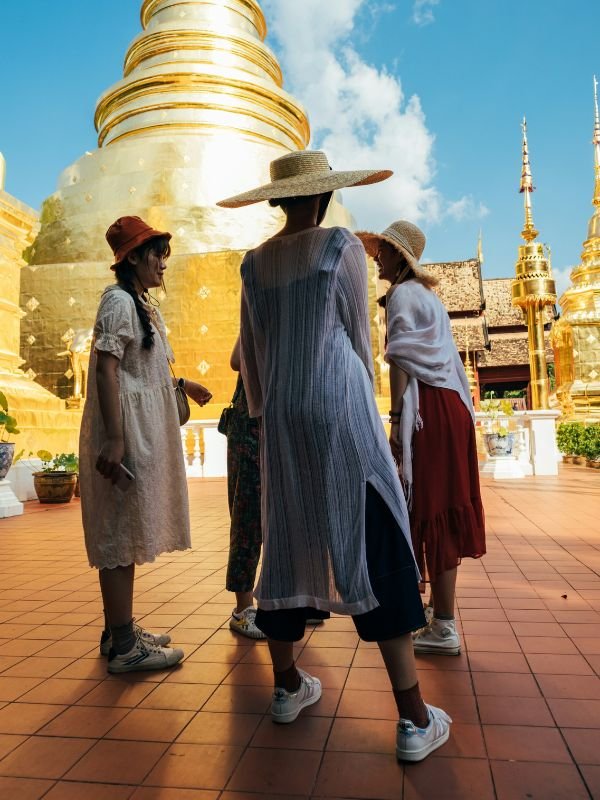
Spend time in spaces with people present. You do not need to socialise — you need to be in proximity to human life. A cafe where you become a regular face, a hotel lobby, a neighbourhood market at the same time each morning. Passive presence around others is enough to shift the emotional register.
Eating alone is its own skill set, and it is more learnable than most people expect. I wrote about exactly how the mechanics work in Dining Alone While Travelling Feels Awkward — But You’re Solving the Wrong Problem.
Add one structured activity if the city is not working. A food tour or a small group walk provides both human contact and forward motion without requiring you to perform extroversion. The structure does the social work; you simply participate.
Slow down. Loneliness and decision fatigue compound each other. If you are moving between cities every few days, the cognitive load of constant reorientation amplifies everything. Staying longer in one place — long enough to become a familiar face somewhere — reduces both. I wrote about exactly why that is in Why Changing Accommodation Too Often Is More Exhausting Than Long Travel Days.
These measures are bridges. The destination is a deliberately designed environment in which loneliness simply has no structural room to exist.
What the Feeling Is Actually Telling You
Loneliness on a solo trip is information. It is rarely a verdict.
When it appears, the useful question is not “Is solo travel right for me?” It is: “What does my current environment lack?” In most cases, the answer is human acknowledgement — not friendship, not constant company, not shared experience. Simply the quiet signal that you are present and recognised.
That is a solvable problem. It is solved by the environment, not by emotional effort.
The woman who sits alone in a keypad-access apartment in a city that doesn’t know she exists is in a structurally different situation from the woman who takes her morning coffee in a lounge where the staff know her name. Both are alone. Only one of them is lonely.
Travel Logistics Planner
A simple framework for thinking through the logistical side of travel — flights, entry requirements, accommodation and transfers — before the journey begins.
Delivered instantly. Occasional thoughtful updates from the road.