
Hoi An has never let me down.
Not once. Not across multiple trips, different seasons, or different stages of my life. I don’t arrive hoping it will work. I arrive knowing it will. That certainty doesn’t come from novelty or excitement. It comes from repetition — from having stayed long enough that the town stopped being somewhere I visited and became somewhere I quietly belonged.
Vietnam is not a low-effort country. Almost every part of it asks something of you. Hoi An is the exception and understanding what it gives back is the difference between a trip that depletes you and one that doesn’t.
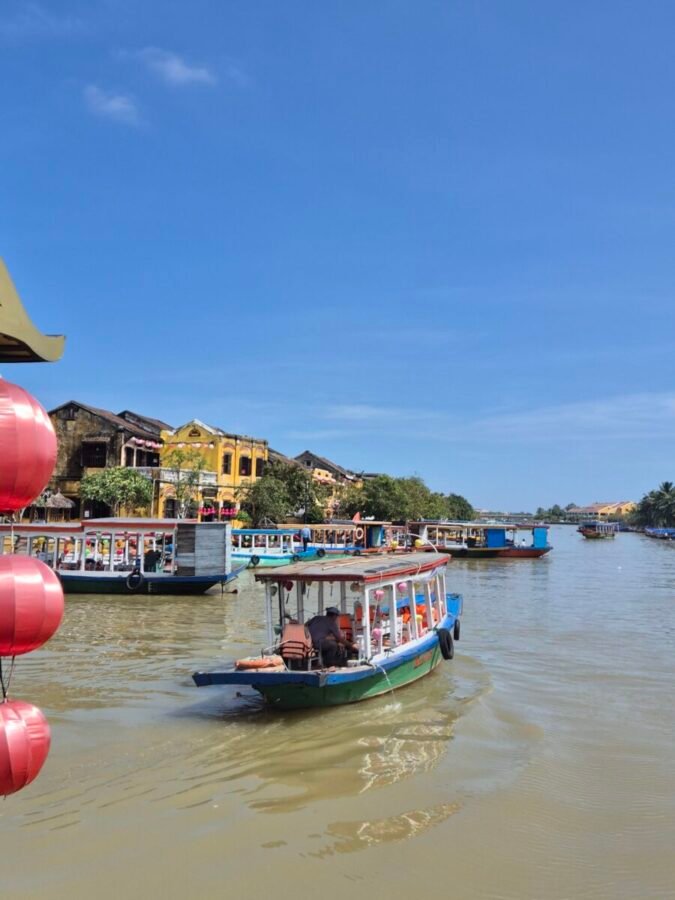
What Vietnam Actually Costs You
Hanoi demands attention from the moment you step outside — I wrote about exactly what that costs you in Hanoi – why I keep going back, even though it’s full on. Ho Chi Minh City is even less forgiving — efficient, dense, and relentless in a way that accumulates faster than most visitors expect. I cover that in detail in Ho Chi Minh City is easy to visit – harder to care about. Even the beautiful parts of Vietnam — the mountain roads, the bays, the long train routes — require energy to navigate. You are constantly adjusting, constantly alert, constantly making decisions.
That is the context that makes Hoi An’s function legible. It is not just a charming town in central Vietnam. It is the place where the nervous system resets. Where the cost of travel stops compounding and begins to be repaid. For anyone moving through Vietnam at any pace, Hoi An is not a nice-to-have. It is the stop that makes the rest of the Vietnam trip sustainable.
But only if you actually stay awhile.
Why a Week Is the Minimum — and a Day Trip Is a Different Place Entirely
The current travel advice circulating about Hoi An is that you don’t need much time there. Some itineraries now suggest doing it as a day trip from Da Nang. Both positions are wrong, and they’re wrong in a specific way: they describe a version of Hoi An that doesn’t work.
A day trip puts you inside the old town during the hours when it is most crowded, most commercialised, and least representative of what the town actually is. You arrive with the tour groups. You move through the main streets with the tour groups. You leave when the day has peaked but before it has settled. You see the surface — the lanterns, the yellow walls, the river at the wrong hour — and you leave thinking you’ve seen Hoi An. You haven’t. You’ve seen what four million visitors a year has done to the parts of Hoi An that face outward.
Day trippers also contribute directly to the overtourism pressure that is actively degrading the place. Hoi An’s population is 120,000. Over four million people visited in 2024. The traffic is concentrated in the old town, at peak hours, and the day tripper model amplifies that concentration. Staying instead of day-tripping is not just better for your experience. It distributes your presence across different hours and different parts of the town and surrounding areas, which is a structurally different thing.
I stay for a week. That is the minimum at which Hoi An begins to work properly. A week gives you enough mornings to make the early walk routine. Enough meals to find the places that aren’t on the main drag. Enough time sitting at the same café that the owner stops registering you as new. Enough slow afternoons that the town’s rhythm starts to feel like your own.
Three days gives you a pleasant stay. A week gives you a different city.
How to Read the Hoi An’s Rhythm
Hoi An receives four million visitors a year and I rarely feel them. That is not luck. It is timing.
I stay at the Hoianan Boutique Hotel, positioned directly in front of the night market, close to the old town but not inside it. That distance is deliberate. It puts me near everything without placing me at the centre of the tourist traffic pattern. The hotel handles laundry through nearby laundrettes at very reasonable prices, which matters more than it sounds for anyone staying a week or longer. These are small structural details that compound across a stay.
Early Morning: Hoi An’s Old Town Belongs to the Locals
The old town before 8am is a different place. The tour groups haven’t arrived. The heat hasn’t built. I take the same walk each time — through the old quarter, down to the Thu Bon river, along the bank while the day is still finding itself. On one of those walks, a local woman stopped near where I was sitting by the river. We talked for a long time. She told me about her life in Hoi An, the tailoring business she runs with her sister at the market. That conversation doesn’t happen at 6pm in a crowd of tour groups. It happens at 7am when the town still belongs to the people who live in it.
Golden Hour and Evening: When and Where to Be
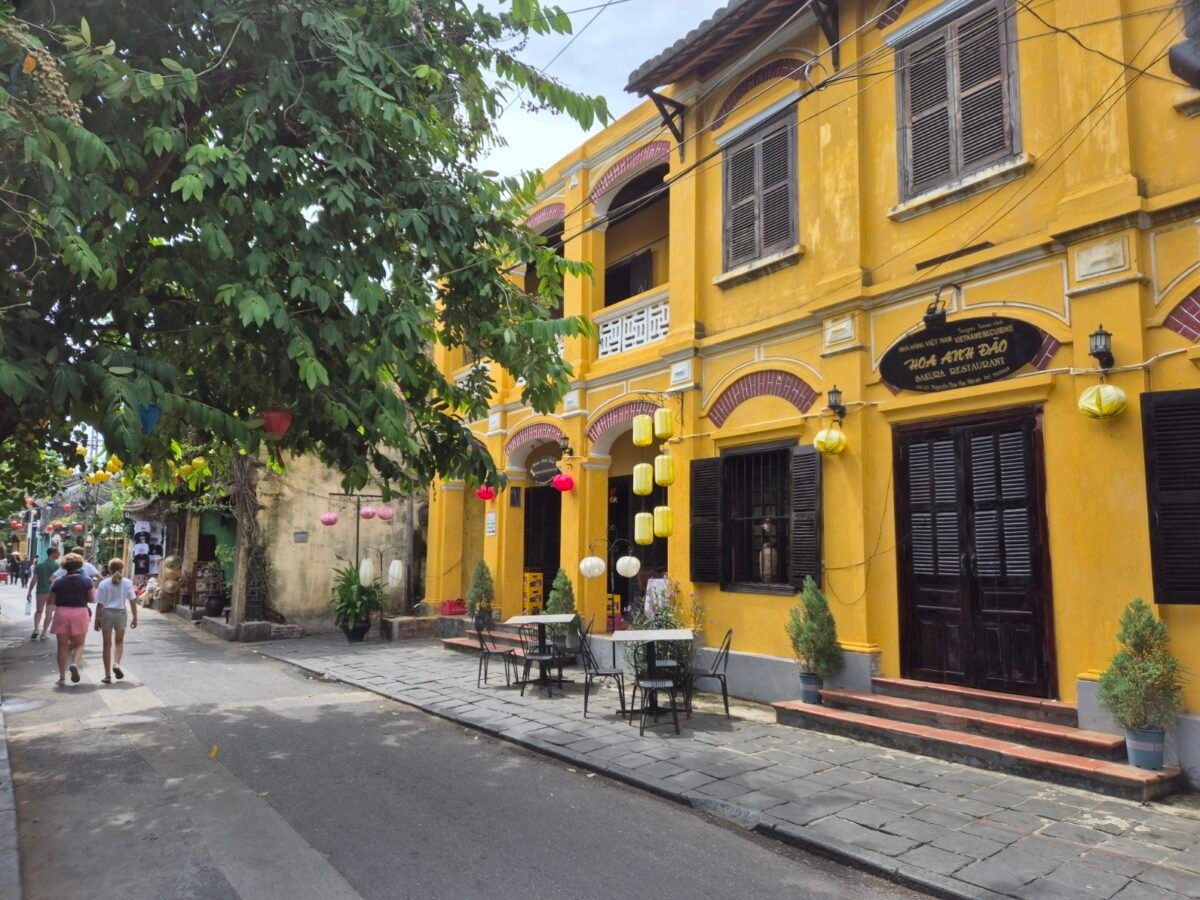
The night market sets up from around 4pm. Golden hour is the time to be there — the light is extraordinary, the stalls are fresh, and the crowds haven’t compressed yet. By 7 or 8pm, when the tour groups are at dinner, the river and the lantern boats are at their most beautiful and most accessible. The old town at that hour is busy. The riverbank at that hour is not that busy. You can still find an empty bench seat by the river.
Where to Eat Is Not Where the Crowds Eat
The restaurants on the main streets serve the tour group circuit. Step into the back lanes or move slightly off the main drag and the picture changes entirely. Nhà Hàng Bảo Phương, just off the night market near the Thu Bon river, serves whole fish wrapped in banana leaves, grilled over open flame. No air conditioning, no tourist pricing, no crowd. The food was good enough that I went back twice. Both times, the restaurant was quiet.

The four million visitors are real. They are also largely predictable — where they go, when they go, what they do. Work around that pattern rather than into it, and the town the travel writers keep trying to describe is still entirely available.
What Hoi An Gives You That Nowhere Else in Vietnam Does
The scale of Hoi An is one of its most underrated qualities. It is a town you can walk without strategy. Not navigating, not calculating routes, not managing exposure to traffic — simply moving through space. That ease is rarer in Vietnam than it sounds, and it produces something specific: the capacity for presence rather than vigilance.
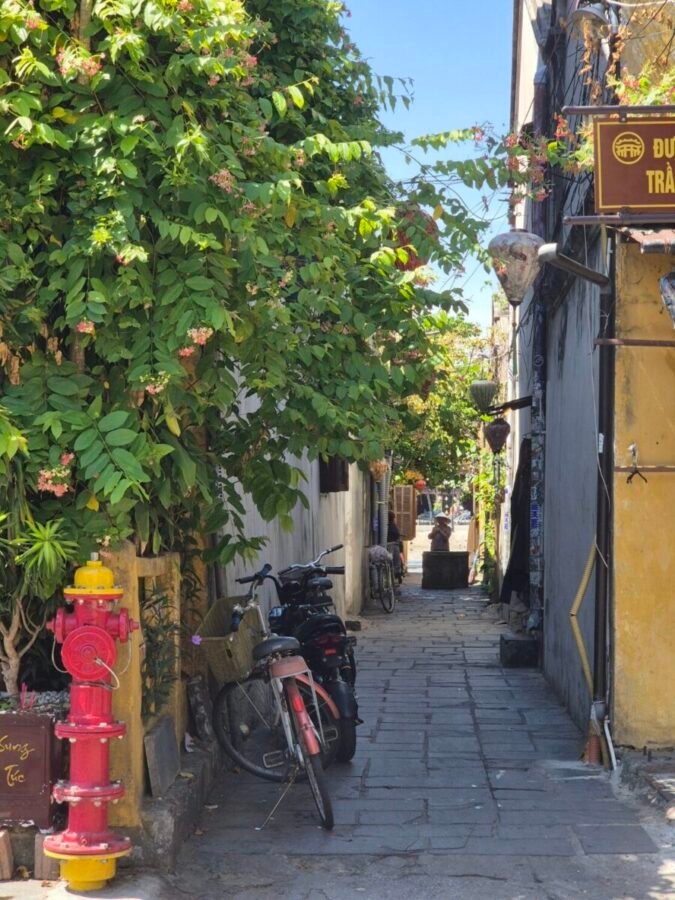
Food is always close. Good food, within minutes, without research. That immediacy keeps days flowing rather than fragmenting around meal logistics. Cafés in Hoi An are places you stay, not stop — you sit, you linger, you see the same faces return. They become anchors. Places where mornings begin and afternoons slow down without effort.
Hoi An is also the one place in Vietnam where I feel completely safe, day or night. The walkable scale, the absence of aggressive street culture, the pedestrian old town — these are structural features, not incidental. For a solo mature woman moving through a country that requires constant low-level alertness, the absence of that alertness is not a small thing. It is part of what makes the nervous system reset here and not elsewhere.
The connections that form here are quieter than elsewhere too. A brief exchange. A remembered preference offered without comment. A familiar smile from someone you pass regularly. These are small moments, but they accumulate into something that feels like belonging — not performed, not sought, simply available to anyone who stays long enough to let repetition do its work.
None of this is available on a day trip. All of it requires time.
Getting To Hoi An
Hoi An has no airport, which is one of the reasons it stays at the pace it does. Da Nang International Airport is the gateway — 45 minutes away by car, well-connected from major Asian hubs including Singapore, Bangkok, Kuala Lumpur, and Seoul, and served by domestic routes from Hanoi and Ho Chi Minh City.
My approach on arrival is a pre-booked private car transfer from Da Nang airport directly to Hoi An. I book this early as part of my logistics planning. It removes every friction point from the first hour — no negotiation, no navigation, no decisions when you’re tired from a flight. You walk out of arrivals and leave. Da Nang airport is also the most straightforward airport in Vietnam for getting a Grab, if that is your preference.
I don’t attempt Grab at Ho Chi Minh City’s Tan Son Nhat or at Hanoi’s Noi Bai — both are complicated enough on arrival that a pre-booked private car is the only sensible option. Da Nang is different. The airport is smaller, the pickup process is simpler, and Grab works without difficulty.
My usual sequence is to arrive via Da Nang, go directly to Hoi An, and stay there for the week. At the end of the Hoi An stay, I call a Grab to Da Nang city for an extended stay before flying out. This ordering is deliberate — starting in Hoi An rather than Da Nang means you arrive at the calmer end of the journey, not after a city transition. Da Nang functions well as an exit point. It is a straightforward city, easy to navigate, and the airport is 20 minutes from the centre.
When to Go — and When to Avoid
February to April is the established sweet spot — dry, clear, and manageable heat. I have also been there in early August and it worked well, though the heat and humidity are more demanding in the middle of the day.
November requires serious attention. Central Vietnam’s wet season runs roughly October through January, and Hoi An floods. In November 2024 I was there and experienced only light drizzle — the town was entirely functional. In November 2025, by multiple accounts, flooding was severe. The old town streets were underwater, mobility was dramatically reduced, and the experience bore no resemblance to the town at any other time of year. November is a genuine risk, not a mild caution. If your dates fall there, understand what you may be arriving into.
The lantern festival falls on the 14th day of each lunar month — every month, year-round. It is worth planning your dates around. The town takes on a different quality entirely on festival nights, and the crowds, while larger, are manageable if you know the timing framework above. The full year’s festival dates are below and use the arrows to navigate to future years for planning purposes.
Hoi An’s Place in the Vietnam Pattern
Every other stop in Vietnam spends you. Hoi An is where you recover what was spent. That is not a soft observation, it is a planning argument. Build it into the itinerary as the reset point, not as an afterthought between cities. Sequence matters: Hoi An works best when it sits between the high-intensity stops, giving the nervous system enough time to actually decompress before the next demand arrives.
For the fuller regional picture — how the north, centre, and south actually differ, and a sample three-week sequence that places Hoi An exactly where it works best — see Planning a Trip to Vietnam? Start With the Region, Not the Circuit.
Hoi An is where I think clearly, work calmly, and feel grounded. It doesn’t demand anything. It simply offers a rhythm and waits to see whether you’ll meet it. Used properly — with enough time, at the right hours, away from the main streets when the crowds compress — it is the most generous place in Vietnam.
Why “Always Works” Matters More Than Novelty
Most travel writing celebrates novelty. The thrill of discovering somewhere new, the excitement of unfamiliar streets, the sense of constant forward movement. There is a place for that. But after enough years on the road, the places that matter most are not always the ones that surprise you. They are the ones that continue to hold you steady.
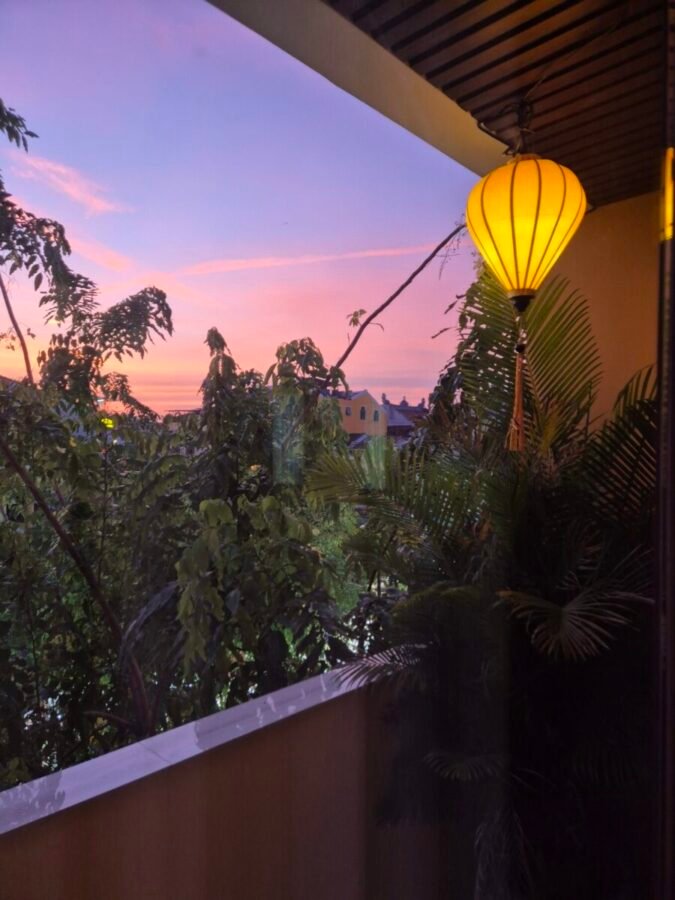
Hoi An has become one of those places for me. Not because it is new, but because it is known. Because I arrive and the reset begins before I have made a single decision. Because the town is still entirely available to the visitor who knows how to be there — despite the numbers, despite the tour groups, despite the travel advice suggesting you can absorb it in a day.
You can’t. And that, more than anything else, is why it always works.
Travel Logistics Planner
A simple framework for thinking through the logistical side of travel — flights, entry requirements, accommodation and transfers — before the journey begins.
Delivered instantly. Occasional thoughtful updates from the road.