
This isn’t an argument that Chiang Mai is “better” than anywhere else in Thailand. And it isn’t a recommendation that everyone should start there.
It’s an explanation of why it worked for me as a first stop — and why sequencing matters more than destination choice when you’re travelling solo later in life.
I didn’t choose Chiang Mai because it was fashionable, cheap, or calming in some abstract sense. I chose it because I wanted my first days in Thailand to feel legible. I wanted to arrive, orient myself, and let my nervous system catch up before asking it to process scale, density, and constant decision-making.
That decision changed everything that came after.
This is about sequencing, not superiority

I didn’t pass through Chiang Mai quickly. I stayed for a month, deliberately moving between four different accommodations so I could experience how the city felt in different pockets — inside the Old City, near the night markets, in Nimman, and close to the Old City’s North Gate. That movement mattered. It showed me that Chiang Mai isn’t a single mood or enclave, but a city with a consistent underlying rhythm that holds even as the surroundings change.
By the time women are travelling solo in their later life, most are no longer interested in testing themselves unnecessarily. They’re not chasing intensity for its own sake. They’re calibrating how a place feels to move through.
First stops carry disproportionate weight because they set the baseline. They establish whether confidence builds or erodes. Whether judgement sharpens or becomes defensive. Whether curiosity opens or closes.
This is why I’ve been so clear elsewhere about sequencing — both in Why I Would Not Start My First Thailand Trip in Bangkok and in Why I Would Never Send a Mature Solo Woman to Phuket or Pattaya First. Those articles explain what didn’t make sense as a beginning.
Chiang Mai, for me, was the constructive counterbalance. Not because it’s perfect, but because it allowed adjustment without pressure.
Why the first week matters more than people admit
The first week of a trip later in life is not about sightseeing. It’s about orientation.
Everything is new:
– the sounds
– the pace
– the way systems work
– the social tone
– the small frictions that don’t register until they accumulate
When those inputs arrive too quickly, the brain interprets overload as risk. That doesn’t mean a place is dangerous. It means the cost of interpretation is too high.
You can push through that when you’re younger. Later in life, pushing through tends to drain energy rather than build confidence.
What you want from a first stop is not excitement. It’s traction.
What “worked” actually means
When I say Chiang Mai worked as a first stop, I don’t mean I fell in love with it instantly, or that every day was effortless.
I mean this:
- I could map the city quickly.
- I understood how to get around without constantly checking.
- I didn’t feel watched, rushed, or extracted from.
- I could make small decisions without them cascading into fatigue.
In other words, I could settle.
What helped me settle wasn’t sightseeing. It was repetition. Taking the same routes. Ordering food without overthinking it. Letting days develop a shape. Chiang Mai was the first place in Thailand where I felt comfortable enough to experiment with everyday logistics — even something as small as using local ATMs. I remember standing at a Kasikorn Bank ATM, realising how simple the English interface was, and feeling an unexpected wave of relief.
That kind of small competence builds confidence faster than any attraction. And once confidence is established, complexity becomes interesting instead of threatening.
Scale matters more than vibe
Chiang Mai is often described as “relaxed” or “laid-back”. I think that misses the point. What mattered more to me was scale.
The city is large enough to function properly, but small enough to remain mentally navigable. Distances make sense. Neighbourhoods repeat patterns. You don’t need to master the place to feel competent inside it.
Scale reduces cognitive load. You spend less time interpreting and more time noticing. Less time bracing and more time engaging.
That matters later in life, when energy is something you manage deliberately rather than burn through.
Sensory load: the quiet advantage
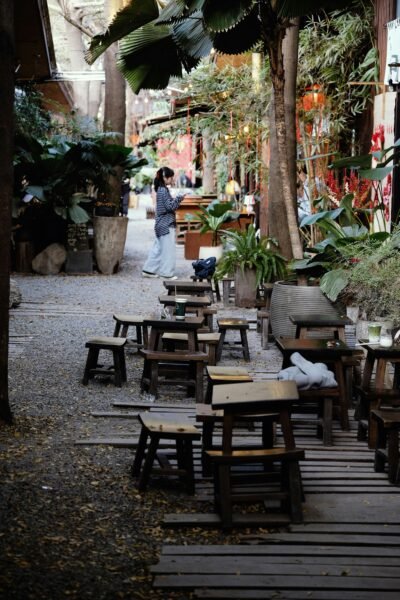
Noise, visual density, and constant motion all carry a cost. Even when you’re not consciously stressed, the body is processing information. Chiang Mai gave me space to absorb Thailand gradually. The pace was active without being relentless. Streets were busy, but not overwhelming. There was movement, but also pause.
Chiang Mai isn’t perfect. Pavements aren’t consistently walkable, and as someone who is admittedly clumsy, I had to pay attention. But traffic wasn’t relentless, and drivers respected crossings. Walking felt manageable rather than tense. I wasn’t constantly bracing myself. That difference matters more than flawless infrastructure.
Calmer doesn’t mean boring. It means the environment doesn’t demand your full attention at all times. That space is what allowed me to notice details — social rhythms, small courtesies, everyday interactions — without feeling like I was constantly on the back foot.
This distinction sits at the core of how I think about Travel Comfort & Pacing — comfort as reduced friction, not indulgence.
Systems without pressure
One of the understated strengths of Chiang Mai as a first stop is that systems exist, but they don’t demand immediate mastery.
Transport is available, but you’re not forced to decode complex networks on day one. Services are accessible without being transactional. Daily logistics can be solved simply.
I relied on Grab (ride share) almost exclusively because I don’t tolerate heat particularly well. That, too, worked without friction. Cars arrived quickly, plate numbers were easy to verify, and payment was automatic through the app. I didn’t need translation tools. I didn’t need to negotiate. I simply moved. When systems work quietly like that, they stop dominating your attention — which is exactly what you want at the beginning of a trip.
That matters when you’re travelling solo later in life. You don’t want your first week to feel like an exam. I wasn’t trying to optimise anything. I was just trying to arrive and feel capable. Chiang Mai supported that without fuss.
Social tone and everyday interaction
Another reason Chiang Mai worked for me was the social tone.
Interactions felt straightforward and non-performative. I didn’t feel pressured to engage or withdraw. Being alone didn’t feel conspicuous. There was no sense that I needed to play a role. For a mature solo woman, that neutrality is valuable. It allows you to show up as you are, without negotiation.
The social tone wasn’t abstract for me — it showed up in small, unprompted moments. When I tripped and fell outside one of my hotels, staff came running out immediately, insisting on helping, then quietly patched me up with a first aid kit after I declined a hospital visit.
At another hotel, a staff member stood with me at the roadside while we waited for my Grab to arrive, as if it was the most natural thing in the world. These weren’t gestures designed for reviews. They were ordinary acts of care and hospitality that the Thai people are famous for.
One moment that stayed with me involved a female Grab driver. In broken English, she told me how brave she thought I was to be travelling solo. She spoke about wanting to do the same one day but not yet feeling ready. We exchanged simple reassurances during the ride — nothing profound, just two women recognising each other’s choices across different lives. That interaction didn’t feel exceptional in Chiang Mai. It felt possible.
This sense of quiet social ease underpins what I frame as Safety & Confidence — not safety as fear avoidance, but safety as the absence of constant self-monitoring.
What Chiang Mai gave me first
What Chiang Mai gave me wasn’t comfort in the soft sense. It gave me confidence.
It allowed me to:
- test my routines
- understand my energy patterns
- observe without being overwhelmed
- trust my judgement again in a new context
That confidence changed how I experienced everything that followed.
When I later spent time in Bangkok — which is now my favourite base in Thailand — I did so from a grounded place. Bangkok didn’t feel like an assault. It felt like a system I could engage with on my own terms.
Timing changed perception completely.
Why this wouldn’t work for everyone
It’s important to say this plainly: Chiang Mai will not be the right first stop for everyone.
Some travellers thrive on scale. Others find quieter cities under-stimulating. There are women who would find Chiang Mai slow, or limiting, or simply not aligned with what they want.
That doesn’t make them wrong.
Ms Grey Nomad is not about prescribing destinations. It’s about helping women recognise fit earlier, so they don’t waste energy overriding themselves.
How this reframed Thailand for me

Starting in Chiang Mai shaped how I understood Thailand as a whole. It allowed me to see the country as layered rather than chaotic. As nuanced rather than contradictory. It made it easier to recognise which environments aligned with me — and which didn’t.
I always visit museums when I travel — they help me understand the emotional architecture of a place. The Chiang Mai City Arts & Cultural Centre left a deep impression on me, particularly in how it framed Northern Thai history and identity. It gave context to what I was seeing on the streets, in temples, and in everyday interactions.
Wat Chedi Luang did something similar. It carried a gravity that reviews didn’t prepare me for. These experiences didn’t overwhelm me because I encountered them from a grounded place.
This is why I look at Thailand as a system, not an itinerary, and why that broader framing lives on the Thailand country page.
Start where your nervous system can catch up
Later in life, travel isn’t about proving anything. It’s about choosing environments that support judgement rather than constantly testing it.
Chiang Mai worked as my first stop because it allowed adjustment without pressure. It gave me a stable base from which to say yes — and no — more clearly later.
That’s the quiet power of sequencing.
You can always choose intensity later. You can always add scale once you’re grounded. But it’s much harder to recover confidence if the first impression erodes it.
For me, Chiang Mai wasn’t the destination that defined Thailand. It was the one that made the rest of Thailand possible.