
Bangkok Is Not the Problem. Timing Is.
Bangkok is the best city in Thailand for long-term living, but it is not the right introduction to Thailand. Those are two different things, and most travel advice treats them as one — which is how so many first visits to this country go wrong before they’ve properly begun.
If you’re planning your first trip to Thailand, I would not start in Bangkok — and if you’re still mapping out your route, start with how Thailand actually works as a travel system. Not because the city is difficult, but because it asks too much of you at the exact point where everything is still unfamiliar — whether that’s the first day in a new country, your first trip overseas, or your first time travelling alone. Start somewhere smaller, then come to Bangkok when you’re ready for it.
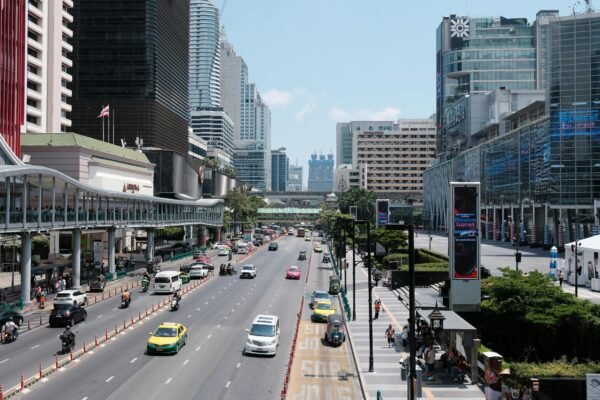
I know this because I started in Chiang Mai rather than Bangkok, not from strategy but from instinct. Something about arriving into a city of that scale felt like too much to navigate on the first day in a new country. I couldn’t have articulated it properly at the time. I just had a sense that I’d rather find my footing somewhere smaller before I asked anything more of myself.
It turned out to be one of the better decisions I’ve made in travel, though not for the reasons I expected. Bangkok isn’t difficult in the way some cities are — but it is dense: sensory, vertical, relentlessly active. When you’re rested, that reads as energy. After a long-haul flight, in unfamiliar heat, it reads as pressure. The city hasn’t changed. Your capacity has.
Today I live in Bangkok for extended periods on a Destination Thailand Visa (DTV), and it’s where I choose to be — for the lifestyle, the healthcare, the transport, the infrastructure that simply works in ways it often doesn’t elsewhere in the region. I return to it because it gives me what I need. But I still wouldn’t send a first-time visitor there on day one.
The issue isn’t Bangkok itself. It’s where it sits in your itinerary — and that’s the part most people don’t think through.
Should You Start Your Thailand Trip in Bangkok?
No, I would not start my first trip to Thailand in Bangkok. Not because the city is difficult, but because it asks too much of you before you’ve had a chance to settle into how things work. Bangkok demands energy, orientation, and decision-making. Start somewhere quieter, then come to it when you can actually experience it properly.
What Actually Goes Wrong
Nothing actually goes wrong in the way most people expect. The first 24 hours of a trip tend to shape far more of the experience than most people realise. It’s the same pattern I describe in The First 24 Hours of Solo Travel: Where Most Mistakes Happen.
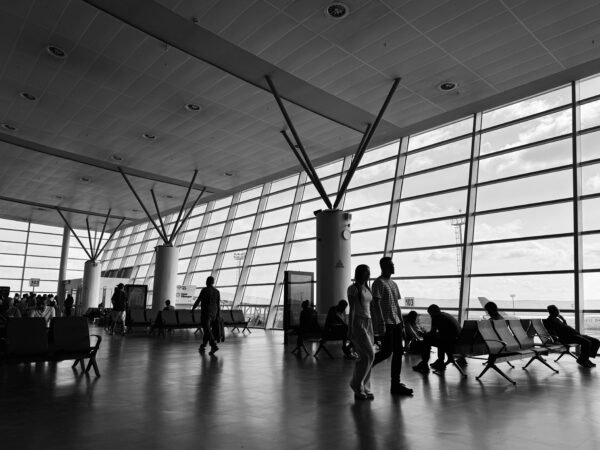
There’s no single incident to point to, no moment where something clearly fails. The problem is quieter than that — and easier to misread. What you’re experiencing isn’t the city at all. It’s a temporary mismatch between what the environment requires and what your body can currently handle.
The difficulty isn’t that Bangkok is demanding. It’s that you encounter it at the exact moment your capacity is lowest and then interpret that strain as something being wrong with the place — which is exactly what I touch on in Why Your Arrival Time Matters More Than Flight Length.
You’re processing scale and noise and heat and unfamiliar systems on top of genuine physiological depletion — jet lag is not tiredness, it’s a full disruption of how the body regulates itself, and it takes longer to clear than most people allow for. Bangkok simply makes that state more visible than a quieter place would. The same fatigue in Chiang Mai reads as a slow morning. In Bangkok it reads as overwhelming.
The distinction matters because once you misread the cause, you draw the wrong conclusion. You don’t think, “I arrived tired.” You think, “This place doesn’t feel right.” And that conclusion tends to stick, because it was formed at the point where your judgement was least reliable.
Skipping Bangkok Doesn’t Solve the Problem
The predictable response to a difficult start is to avoid Bangkok altogether and go somewhere that’s presented as a better way to begin a Thailand trip — without much clarity on what that actually means. This is how first-time visitors end up in Phuket or Pattaya — and it is, in most cases, a worse outcome than a difficult week in Bangkok would have been.
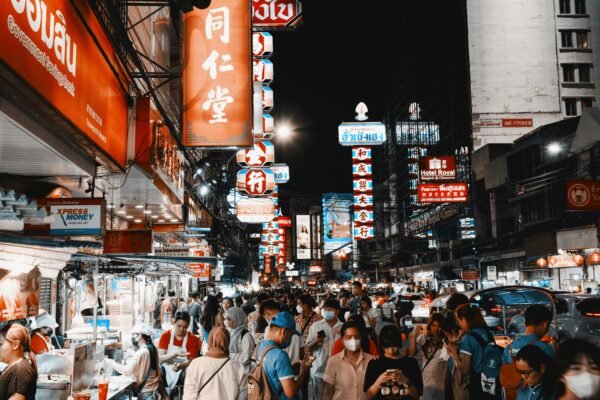
I’ve been to Phuket once and I won’t go back — I explain that decision more fully in Why I Would Never Send a Mature Solo Woman to Phuket or Pattaya First. It wasn’t the crowds or the cost, though both are real.
Phuket’s tourist economy is substantially built around sex tourism, and that shapes everything about how the place feels. The street-level dynamic, the transactional register of interactions, the gap between what you’re walking through and the Buddhist culture that underpins how Thailand actually functions everywhere else. That gap is not subtle, and first impressions are sticky. Women who start in Phuket often leave thinking they’ve seen Thailand. They’ve seen one of its least representative corners, and the filter it was seen through has very little to do with the country.
Pattaya is a more concentrated version of the same environment — and it’s not somewhere I’ve chosen to go. On recent trips I’ve spent three weeks across Sri Racha and Rayong, staying in the Novotel properties in each town. Both sit close enough to the coast to be convenient without having been shaped by that industry. The guests at both hotels were predominantly Thai, which tells you something important: these are towns that still orient toward how locals actually live. That’s a more honest introduction to the country than anything Phuket or Pattaya offers.
Skipping Bangkok doesn’t automatically make Thailand more accessible. Sometimes it leads to a version of the country that puts women off entirely — and that’s a harder thing to come back from than a tiring first week in a city that would have made more sense later.
What to Do Instead
If you’re not starting in Bangkok, start somewhere that lets your body catch up before your environment starts demanding decisions. That usually means a smaller, slower city — not because it’s better, but because it gives you space to stabilise before you need to navigate anything complex.
In Thailand, that typically looks like Chiang Mai. It’s not the only option, but it’s the most reliable one — manageable scale, lower sensory load, and just enough infrastructure to make your first few days feel straightforward rather than effortful.
Chiang Mai worked precisely because it made no great demands, which is exactly why Chiang Mai Was the Perfect First Stop — and Here’s Why It Worked. The streets are navigable, the pace is slower, the sensory load is lower. By the time I arrived in Bangkok I was rested, I was oriented, and I was ready to meet the city on its own terms rather than on my worst day. When I did, it was a completely different experience, not because Bangkok had changed, but because I was no longer meeting it on my worst day.
That’s the difference. You’re not avoiding Bangkok — you’re arriving at it with something to work with.
The Bangkok You Don’t See on a Short Stay
The DTV changed my relationship with Bangkok in a way I didn’t anticipate. When you’re passing through on a one or two-week trip, you see the city’s surface — the landmarks, the famous streets, the food that’s easy to find. You leave with an impression, and that impression may be accurate as far as it goes. It just doesn’t go very far.
Bangkok is a city that reveals itself in layers, and those layers have a sequence. The tourist infrastructure comes first — efficient, well-worn, designed to be found. Underneath it are the neighbourhoods that don’t orient toward visitors at all.
The Em District is one of them: anchored by EmQuartier, Emporium and Emsphere shopping mall complexes along Sukhumvit, it functions as a genuine residential and professional hub rather than a tourist precinct. For a first-time stay, the Em District works well precisely because it removes friction rather than adding to it. The people using it are largely locals going about ordinary life — eating, working, moving through the city.
The Em District doesn’t appear on most first-trip itineraries, which is precisely why it’s worth knowing about. It’s also where I tend to base myself for longer stays. Benchasiri Park is a short walk away, Phrom Phong and Asok BTS stations are both within walking distance, and there’s a wide range of restaurants nearby that you’re not constantly having to decide where to eat.
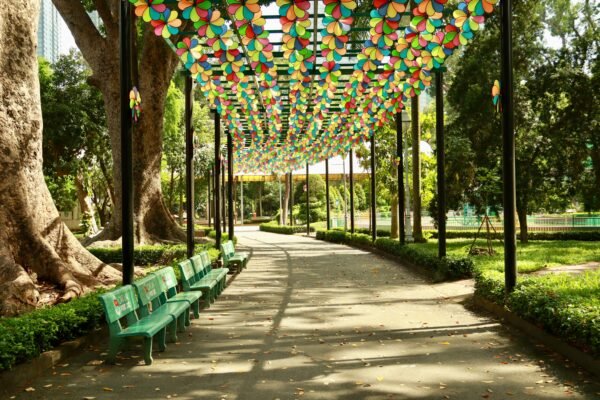
On a DTV stay, Bangkok stops being a destination and becomes a place you inhabit. That’s a different thing entirely. The city that felt like a lot to process on arrival becomes, over weeks, genuinely legible — its rhythms, its logic, the way different parts of it function at different hours. If a short visit left you uncertain about Bangkok, I’d say this, the impression you formed was probably of the outer layer. Give it longer, or come back. The city you didn’t quite reach is worth finding.
Bangkok When You’re Ready for It
Once the jet lag has cleared and you’ve had a few days of navigating something manageable, Bangkok becomes exactly what it is: one of the most functional, convenient, and genuinely interesting cities in Southeast Asia. The BTS and MRT runs on time. The hospitals are world-class. The food is extraordinary at every price point.
Once you’re rested, the city becomes not just manageable, but predictable — including from a safety perspective, which is often misunderstood on first arrival.
The infrastructure works reliably and consistently — second only to Singapore in the Southeast Asia region, and that difference shows up quickly once you’re moving through the city. I’ve written about how Singapore works in a way other cities don’t.
For long-term living especially, Bangkok is difficult to beat — which is why I keep returning to it, and why it’s become the fixed point around which the rest of my time in Thailand organises itself. None of that changes based on when you arrive. What changes is your ability to receive it properly. Start somewhere smaller, come to Bangkok when you have something to bring to it, and it will be considerably more than you expected.
Travel Logistics Planner
A simple framework for thinking through the logistical side of travel — flights, entry requirements, accommodation and transfers — before the journey begins.
Delivered instantly. Occasional thoughtful updates from the road.