
Phnom Penh is not difficult in the way people expect. It is not overwhelming, and it is not chaotic in a way that prevents movement. What makes it harder is quieter than that. There is an expectation that the city will begin to come together over time — a rhythm, a sense of place, something that holds attention — and it never quite does. Adjustments get made, different areas get tried, a bit more time gets given, and the return does not really change. The effort remains, but the experience does not deepen.
This shows up in small, practical ways. Some parts of the city feel comfortable enough, but they do not connect to anything beyond themselves. Other areas feel harder to sit in, not because they are unfamiliar, but because they do not give a reason to stay. Even the places that should anchor the experience do not fully open up or hold attention for long. The difference between areas is not subtle, but it also does not resolve the underlying problem.
Understanding Phnom Penh starts with accepting that it does not operate as a city that builds on itself. It does not reward movement, and it does not reward staying longer either. Where a base is chosen affects how much friction is felt, but it does not change the overall return. That pattern becomes easier to recognise when stepping back and looking at how the country operates more broadly in Cambodia at a Glance — A Decision Framework, where the same unevenness shows up at a structural level.
Arrival Into Phnom Penh Now Requires More Planning
Arrival into Phnom Penh has changed with the opening of Techo International Airport, which is located well outside the main city area in a newly developed zone.
There is currently very little around the airport itself. It does not connect directly to any established part of the city, so the journey into Phnom Penh becomes a necessary part of arrival rather than a simple continuation of it.
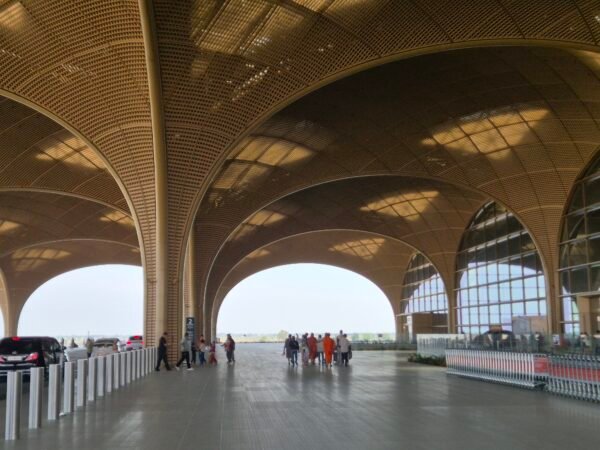
In practical terms, the transfer into central Phnom Penh typically takes around 45 minutes to 1 hour, depending on traffic. During peak periods, it can take longer. This is not unusual for a city of this size, but it does mean arrival requires more consideration than before.
One detail to be aware of is that drivers are not allowed inside the terminal. They wait outside, so you will need to exit the arrival hall to meet your transfer.
Given the distance and the lack of surrounding infrastructure, it is best to arrange a private car transfer in advance rather than trying to organise transport on arrival. This removes unnecessary friction at the point where the journey is already at its longest.
It is a small detail, but it reflects the same pattern seen throughout Phnom Penh — a little more effort required before anything is gained.
This connects directly to Why Your Arrival Time Matters More Than Your Flight Length, because the final leg into the city is no longer immediate, and how that first hour unfolds will shape how the stay begins.
Phnom Penh Only Feels Manageable in Certain Parts of the City
There is an assumption many travellers carry into capital cities that things will gradually start to make sense. A centre reveals itself, movement becomes intuitive, and different parts of the city begin to connect in a way that allows a few days to unfold without much effort.
Phnom Penh does not behave like that.
What stands out is not chaos, but unevenness. The city does not present as a single, cohesive experience. It breaks into pockets that feel workable, then quickly gives way to areas that feel disconnected from anything around them. Time spent moving across Phnom Penh does not consistently deepen the experience. Quite often, it simply exposes how little the city builds on itself.
That unevenness matters because it changes the return on effort. Movement requires more attention than expected, and the outcome rarely improves in proportion to that effort. Location, in this context, is not a preference. It becomes the difference between a stay that holds together and one that feels harder than it needs to be.
Where Phnom Penh Holds Together Best
The Riverside and BKK1 are the two areas where Phnom Penh feels most contained, but they work for different reasons.
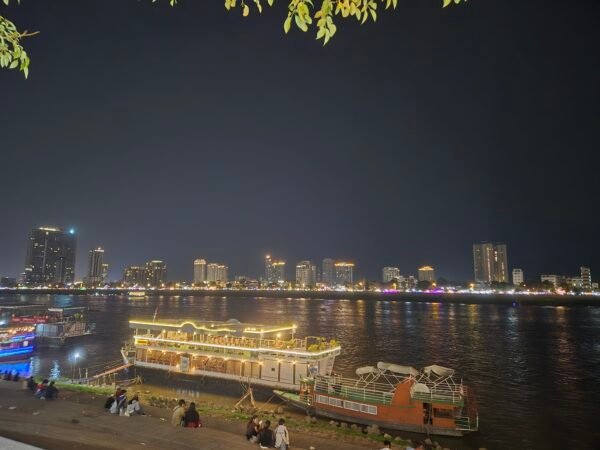
Along the river, Sisowath Quay forms one of the few continuous walking stretches in the city. It connects the Royal Palace Phnom Penh, the National Museum of Cambodia, Wat Ounalom, and the night market area.
That physical continuity matters. It creates a sense of movement that does not need to be constantly negotiated, and it keeps key points of interest within a manageable range of each other. The river itself opens up the space visually, which is something much of Phnom Penh lacks once you move inland.
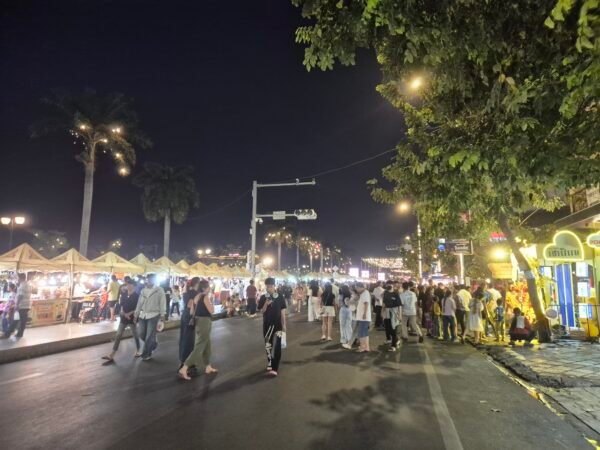
BKK1 functions differently. It is not quieter or more local, but it is more contained in terms of daily needs. Restaurants, cafes, accommodation, and services are concentrated enough that the day does not require constant planning. The streets still carry traffic and noise, but the environment is predictable.
Bassac Lane sits just off this area and reinforces that pattern. It is a compact cluster of bars, restaurants, and small venues that concentrates evening activity into a short, walkable stretch. It does not define Phnom Penh, but it gives BKK1 something the rest of the city often lacks — a contained space where the experience holds together without needing to move across multiple districts.
These areas do not transform Phnom Penh into a more compelling city. What they do is reduce the friction of being there. In a place where effort does not always translate into experience, that reduction becomes noticeable very quickly.
There is a similar pattern in Jakarta Is Not a City You Explore — It’s One You Go To With a Purpose, where the city also makes more sense once expectations shift away from free movement and towards a more contained way of approaching it.
Outside Those Areas, the Return Drops Quickly
Beyond the Riverside and BKK1, Phnom Penh becomes much less comfortable to move through.
The issue is not only that areas feel less connected. It is that other concerns start to surface more quickly. Scams become more noticeable. Safety requires more active awareness. Movement feels less intuitive, and the environment does not support the same level of ease.
There is also a visible shift in how the city presents itself. In parts of Phnom Penh, Chinese signage dominates the streetscape, and entire stretches feel oriented towards a different audience. The atmosphere and culture changes. It no longer reads clearly as a Cambodian city, but as something more commercially overlaid and externally driven.
This changes how the city feels, and not in a way that adds to the experience. It means they require more effort to interpret, more effort to move through, and more effort to feel comfortable in — without offering much in return. That is where Phnom Penh starts to feel harder than it should.
There is a useful contrast in Luang Prabang Doesn’t Try To Be More Than It Is. Luang Prabang is limited in scale, but it holds its shape. Phnom Penh has more movement, more density, and more visible activity, yet often feels thinner as an experience because it does not accumulate into something more cohesive over time.
Why Phnom Penh Feels Like There’s “Nothing to Do”
One of the most common reactions to Phnom Penh is that there is “not much to do.” Phnom Penh offers very little for a short stay. There are only a handful of places most visitors would realistically consider, and even those do not fully deliver in the way you might expect from a capital city.
What Looks Like It Should Work — But Doesn’t Fully Deliver
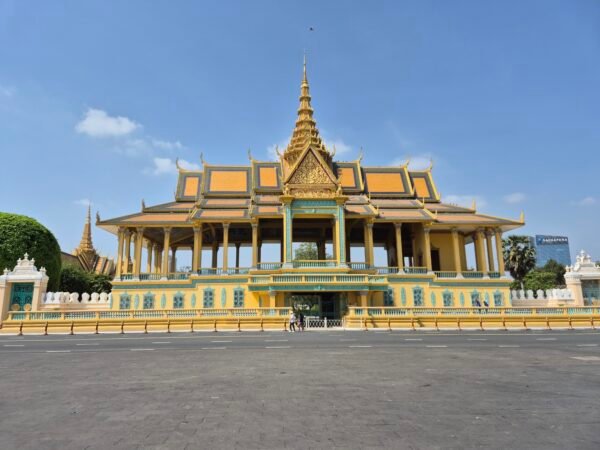
The Royal Palace Phnom Penh should be one of the main highlights. From the outside, it looks like it will carry a large part of the experience. In reality, access within the grounds is limited. Many buildings are not open to visitors, and the visit does not take long. It does not anchor the day in the way a major site usually would. What should feel like a centrepiece ends up feeling partial.
The One Place That Holds Its Own
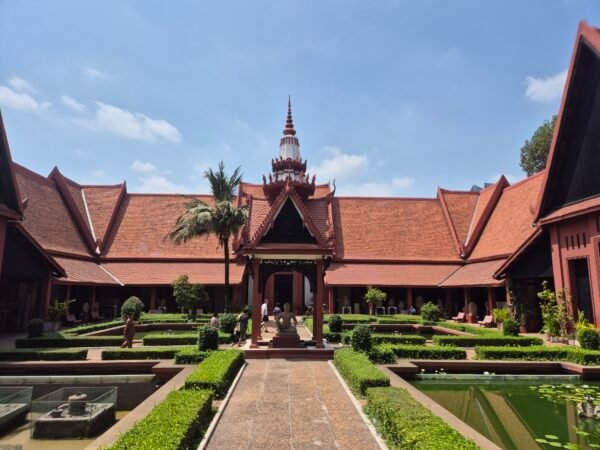
The National Museum of Cambodia is different. It is one of the strongest museums in Southeast Asia, with a serious collection of Khmer sculpture and artefacts that reflects the depth and continuity of Cambodian civilisation. The layout is coherent, the pacing is manageable, and the central courtyard creates a sense of calm that is noticeably absent outside its walls. This is not a filler stop. It is a complete experience that holds attention from beginning to end.
The Weight of What Is Considered “Essential”
That leaves the two sites most often described as essential: the Tuol Sleng Genocide Museum and the Killing Fields. These are not casual visits. They are heavy, confronting, and emotionally draining. These do not sit alongside a broader day of exploration, and tend to define the day entirely once visited.
They were not part of my stay. Not because they are unimportant, but because the historical context is already understood. There is no need to revisit that experience in a way that is emotionally overwhelming.
Respect for what happened does not require reliving it in that form. The focus, instead, was on engaging with the present — the culture that continues, and the resilience of the Cambodian people.
Once those are set aside, there is very little left.
There is a clear contrast in Siem Reap Works — Until You Try To Do Too Much, where the structure of the city carries multiple days without effort. Phnom Penh does not do that. It asks for time, but it does not give enough to sustain it.
Cambodia Today Is Not Defined by Its Past — And So Is Phnom Penh
One of the most noticeable things about Phnom Penh is not what happened here decades ago, but how people live now.
There is an assumption, often unspoken, that a city with Cambodia’s history will carry a visible heaviness — that it will sit close to the surface, shaping the atmosphere in a way that is immediately felt. Phnom Penh does not present itself like that.
What comes through more clearly is something else entirely.
There is an openness in the way people engage. Conversations are easy, interactions are unguarded, and there is a natural friendliness that does not feel performative or transactional. It shows up in small moments — in the way staff greet you without hesitation, in the ease of everyday exchanges, in the willingness to help without being asked twice. There is a lightness to these interactions that sits in quiet contrast to what the country has lived through.
That contrast is what stays with you.
It is not that history is absent. It is present, but it does not define the way people move through their daily lives. What stands out instead is a forward-facing energy — a sense that life continues without being held in place by what came before. There is resilience here, but it does not present as something heavy or burdened. It presents as something active, lived, and quietly optimistic.
This is easy to miss if an entire visit is structured around sites like the Tuol Sleng Genocide Museum and the Killing Fields, where the experience is necessarily focused on the past.
Outside of that, a different Phnom Penh becomes visible.
It appears in cafes, in hotel lounges, in everyday street-level interactions — not as something curated, but as something that simply is. The city may not offer a strong lineup of activities, but the human experience within it carries a warmth that is difficult to ignore once noticed.
This is not about dismissing history or reducing its significance. It is about recognising that Cambodia today is not defined by it in the way many expect and Phnom Penh, for all its limitations as a destination, reflects that shift more clearly than anything else in the city.
Phnom Penh Is Not About the City — It’s About the People
Phnom Penh does not stay with you because of its landmarks, its structure, or even how the city itself is put together.
What stays is something else.
It shows up in the way people engage — openly, without hesitation, and without the guardedness that often sits beneath interactions in more developed cities. Conversations are easy to start and just as easy to continue. There is a natural friendliness that does not feel rehearsed or transactional, but simply part of how people move through their day.
There is also a lightness to it.
Not in the sense that the country’s history is absent, but in the way it is carried. It does not sit heavily on the surface of everyday life. What comes through more clearly is a forward-looking energy — a sense that people are not defined by what has happened, but by how they continue.
That is not something easily explained until it is experienced directly.
It appears in small moments — in hotel lounges, in cafés, in simple exchanges that are not planned or curated. The city itself may not offer a strong sequence of things to do, but the human experience within it carries a warmth that is immediate and consistent.
That is where Phnom Penh works. Not as a city that unfolds through attractions or structure, but as a place where the experience is shaped by the people within it. The resilience is visible, but it does not present as something heavy. It presents as optimism, as openness, and as a willingness to engage with the present rather than remain defined by the past.
And once that is recognised, the city begins to make more sense. Not because there is more to do, but because the expectation changes. Phnom Penh does not reward effort in the way other cities do. But it offers something else — a human experience that is immediate, open, and quietly resilient.
Travel Logistics Planner
A simple framework for thinking through the logistical side of travel — flights, entry requirements, accommodation and transfers — before the journey begins.
Delivered instantly. Occasional thoughtful updates from the road.