
Yogyakarta is not the kind of place you stumble into.
It tends to sit on your list for a long time, anchored to two specific names that come up again and again — Borobudur and Prambanan. They carry enough weight on their own that you don’t need much else to justify the trip. These are not incidental stops or optional additions. They are the reason the city exists on your route in the first place.
The decision is made before you arrive.
You don’t come here to explore broadly or see what unfolds. You come because something specific is here, and that alone determines how the trip will take shape.
If you’re trying to understand how Yogyakarta fits into a broader Indonesia trip, it helps to see how different cities behave rather than just what they offer on the Indonesia decision framework.
A Place Built Around a Clear Purpose
Some destinations require you to figure them out as you go. Yogyakarta doesn’t. The structure is already there, and it begins with the temples themselves.
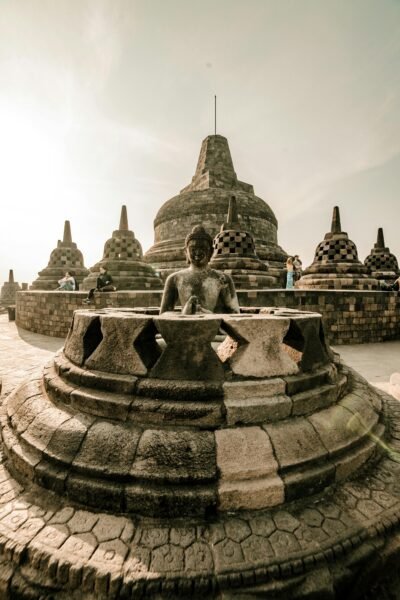
Borobudur usually draws people in first. A 9th-century Buddhist monument built in layered stone terraces, it sits low against the surrounding landscape, its relief panels wrapping around the structure in quiet, repeating sequences. Reaching it often means an early start, timing your arrival around light and access, and allowing enough space to move through it without rushing. It is not something you pass through quickly, even when the visit itself is contained.
Prambanan sits differently. Also 9th century, but Hindu rather than Buddhist, it rises upward in sharp, defined towers that feel more vertical and precise. The complex carries a different rhythm — less expansive, more structured — and the experience unfolds in a way that contrasts with Borobudur rather than replacing it.
Together, they don’t just give you something to see. They define how your time is organised.
Both sites sit outside the city, which means your days begin to form around them almost automatically. There are fixed points you need to reach, transport that has to be arranged, and a natural return to the city once you’re done. What sits in between is not something you need to actively construct.
That’s where Yogyakarta starts to behave differently.
The City Doesn’t Fight You
Scale shifts the experience more than most people expect.
Yogyakarta runs on short, simple movements rather than long, fragmented ones. Most days don’t involve crossing the city multiple times or stitching together different districts just to make an itinerary work. Distances are manageable, and the transport layer is straightforward enough that getting around doesn’t become the main task of the day.
A similar contained structure exists in Chiang Mai Was the Perfect First Stop — and Here’s Why It Worked, although the cost dynamics don’t shift the stay in the same way.
In practice, most people rely on Grab or Gojek.
Cars are easy to book, inexpensive, and widely available, especially within the main city area. Short rides between your hotel, Malioboro, restaurants, and nearby spots tend to be predictable in both time and cost. Motorbike taxis are even more flexible if you’re comfortable with them, cutting through traffic and reducing waiting time further.
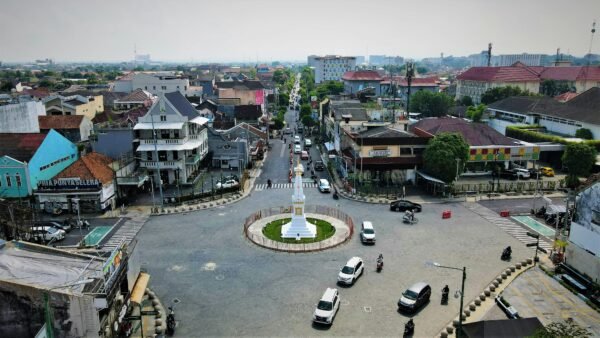
For shorter distances, walking is possible in pockets, but it isn’t something you rely on for the entire day. Pavements can be uneven, crossings are not always clear, and the heat builds quickly by late morning. Movement tends to be a mix — short rides when needed, with limited walking layered in where it makes sense.
What you don’t get is the kind of logistical drag that shows up elsewhere.
There are no complex train systems to navigate, no multi-line transfers, and no need to plan routes in advance just to get from one area to another. You’re not dealing with long travel times that force you to group activities together or optimise every stop.
Instead, the city holds together on its own.
A ride can be booked when you need it. A return to the hotel is easy. Plans don’t need to be tightly sequenced to work. That removes a layer of coordination that often goes unnoticed until it’s gone.
Once that friction disappears, something shifts.
You’re no longer managing movement as a constraint. You’re simply moving when it’s needed, and leaving it alone when it isn’t.
Easy in the City, Less Easy to Reach
Yogyakarta feels contained once you are inside it, but it doesn’t sit as easily on the map as that experience suggests.
For most travellers, Jakarta is the entry point into Indonesia, which means Yogyakarta comes as a second step rather than part of the initial arrival. The flight itself is short — just over an hour — but it introduces another layer into the trip. What looks close in distance still requires a separate movement, another airport, and another transition before you are actually there.
This is a pattern that becomes clearer when you look at Jakarta Is Not a City You Explore — It’s One You Go To With a Purpose and how differently it behaves as a starting point.
The same pattern shows up in Bali and the contrast becomes clearer when you look at Bali Still Works — But Only If You Stop Expecting It to Be Easy, where movement and cost behave very differently.
Flights from Denpasar to Yogyakarta exist and run regularly, with flight times of around one and a half hours. Even so, it doesn’t feel like a continuation of Bali in the way you might expect. The route sits slightly apart, requiring a deliberate shift rather than flowing naturally from one place to the next.
Arrival doesn’t resolve that distance immediately.
Yogyakarta International Airport sits well outside the city, and the final leg stretches longer than most people anticipate. A car transfer into central Yogyakarta can take close to two hours, depending on traffic. The journey is straightforward, but it is not quick, and it extends the sense of distance even after you have landed.
That contrast holds.
Reaching Yogyakarta takes more effort than it appears to at first glance, yet once you arrive, the city itself does not carry that same weight. The movement becomes shorter, the structure more contained, and the trip begins to settle into something much easier.
Where the Trip Quietly Changes
The shift in Yogyakarta doesn’t come from the temples. It comes from the hotels.
For a city of this size, the concentration of full-service, high-quality hotels is unusually high. International chains, large resort-style properties, and well-equipped business hotels sit across the city at price points that don’t align with what you would expect elsewhere in Southeast Asia.
This is not Bali.
There is no positioning around luxury, no emphasis on villas or resort living, and no expectation that you are coming here for the stay itself. Yet the pricing tells a different story. Rooms that would feel occasional or deliberate in other cities — where you might hesitate before booking multiple nights — sit within reach here without the same trade-off.
That imbalance is what changes the trip.
A better room is no longer something you justify for one or two nights. It becomes something you can hold for the duration of the stay without feeling like you are overcommitting.
Why the Stay Starts to Matter
In most destinations, the hotel sits in the background.
You leave early, return late, and treat it as a base between everything else you are trying to do. The value sits outside the room, which is why extending a stay rarely makes sense unless there is more to see.
Yogyakarta doesn’t behave like that.
The temples anchor the trip, but they don’t occupy the entire day. Once you’ve structured your visits around Borobudur and Prambanan, there is space left over — not as a gap to be filled, but as part of the natural shape of the trip.
What happens in that space depends on where you are staying.
Properties like Hyatt Regency Yogyakarta, Yogyakarta Marriott Hotel, The Phoenix Hotel Yogyakarta – MGallery Collection and Grand Mercure Yogyakarta offer full-scale facilities — large rooms, lounges, pools, and restaurants — at rates that remain unusually accessible for this level of stay. Time can sit inside these spaces without feeling constrained or transactional.
That difference is what removes the pressure to leave.
Why It Doesn’t Make Sense to Leave Quickly
Getting to Yogyakarta takes effort. It sits outside the main flow of a typical Indonesia route, requiring a separate flight and a long transfer into the city. That alone makes it a place you choose deliberately rather than arrive at by default.
Once you’ve made that effort, compressing the stay into one or two nights starts to feel misaligned.
The temples can be done quickly. That part is true. What doesn’t follow is the need to leave immediately after. The conditions don’t support that kind of movement. The city is contained, the structure is already set, and the cost of staying well does not push you out.
Extending the stay is not something you need to justify. It becomes the more consistent decision once you are already there.
Why Yogyakarta Works for Hotel Status and Loyalty Strategy
Across multiple hotel groups — Hyatt, Marriott, IHG, Accor — Yogyakarta holds a concentration of properties where nightly rates remain low relative to the quality of the stay. That changes how you use the city. Nights can be extended without the usual cost pressure, and those nights are not spent in compromise.
For anyone holding hotel loyalty status, or working towards renewal, the logic becomes even clearer.
Instead of separating a “status run” from the rest of your travel, Yogyakarta allows it to integrate into the trip itself. Nights accumulate in a place where you are already comfortable staying, where the facilities are strong enough to support time spent inside the hotel, and where the cost does not distort the decision.
This is exactly the kind of system shift I break down in Why I Sold My House and Live In Hotels Instead. What would feel forced in another city becomes natural and economical here.
A Trip That Doesn’t Need to Be Rushed
Most short destination trips are structured to end quickly. You arrive, see what you came for, and leave once that purpose has been completed. Yogyakarta doesn’t create that same endpoint.
In this piece on Osaka Is Welcoming — Even If It’s Not a City I’d Return to, I explain why cost and movement naturally compress how long you stay.
Borobudur and Prambanan give the trip its reason, but they don’t create enough weight to push you out once you’ve seen them. What follows is not a need to move on, but a set of conditions that make staying the more consistent choice.
The hotel layer is what shifts that.
For a city of this size, the number of full-service, high-quality hotels at relatively low price points is difficult to find elsewhere in Southeast Asia. Comparable stays in other cities would cost materially more, which naturally limits how long you remain. Here, that constraint doesn’t exist in the same way.
Cost stops being the reason you leave.
Getting to Yogyakarta already requires an extra step — a separate flight and a long transfer into the city. Once that effort has been made, leaving immediately after completing the temples doesn’t align with how the trip is structured.
Nothing is pushing you out.
The city is contained, movement is manageable, and the stay holds its value across multiple nights without changing the equation. Time doesn’t need to be compressed to make the trip feel worthwhile.
That’s the difference. Yogyakarta gives you a clear reason to come, and then removes the usual reasons to leave.
Travel Logistics Planner
A simple framework for thinking through the logistical side of travel — flights, entry requirements, accommodation and transfers — before the journey begins.
Delivered instantly. Occasional thoughtful updates from the road.