
Siem Reap is one of those places that seems straightforward on the surface. It is easy to arrive, easy to move around, and easy to understand within a few hours. Nothing feels particularly demanding, and for that reason, it is often treated as a short stop — something to “get through” on the way to Angkor.
And yet, many travellers leave more tired than they expected, with a lingering sense that the experience did not quite come together. Not because anything went wrong, but because the way the trip was structured never allowed the place itself to settle.
The problem is not Siem Reap. It is that most trips are built around Angkor in a way that overrides how the city actually functions.
Once you separate those two — the intensity of Angkor and the underlying rhythm of Siem Reap — the place becomes much clearer. That shift tends to happen when you step back and look at how the country operates more broadly, which is where Cambodia at a Glance — A Decision Framework becomes useful in understanding why things feel the way they do on the ground.
Siem Reap Is One of the Easiest Cities to Settle Into
What becomes apparent quite quickly is that Siem Reap does not ask very much of you.
The systems are simple, but more importantly, they are consistent. You are not constantly adjusting or second-guessing small decisions in the way you might in other parts of Southeast Asia. Things work in a way that allows you to move through the day without carrying unnecessary mental load.
Language removes more friction than you expect
Language is a large part of that. English is not just functional; it is comfortable. Conversations do not require effort or negotiation, whether you are checking into a hotel, ordering food, or arranging a car. That removes a layer of friction that you only notice once it is no longer there.
Food does not require planning
Food follows the same pattern. There is enough range — local, Western, familiar, and new — that you do not have to plan around it. You are not solving for meals. You are simply eating when you are ready, and that small shift changes how the day unfolds.
Where you stay shapes how the city works
Accommodation reinforces this ease, not just in quality but in how it positions you within the city. I stayed at Ibis Styles Siem Reap, right in the heart of town, within minutes of Pub Street, local and international restaurants, and both the night and day markets. That kind of placement removes the need to plan your movements. You step outside and the city is already available to you.
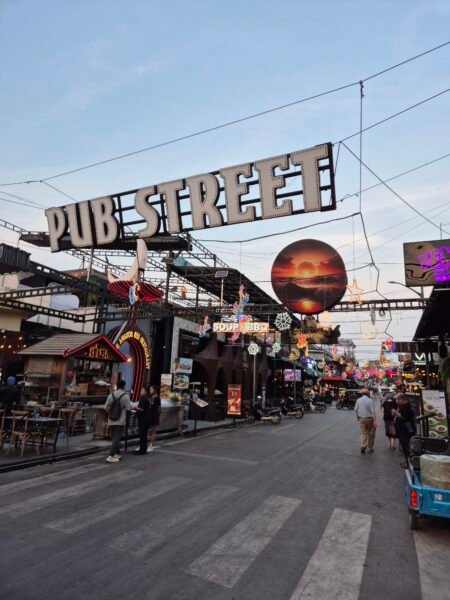
More broadly, this is also where Siem Reap fits cleanly into a wider hotel ecosystem. The presence of multiple Accor brands within a compact area means you are not making isolated booking decisions each time you arrive. You are operating within a system that recognises you, standardises service, and reduces the small frictions that tend to accumulate over a longer trip.
That continuity is what allows a short stay to extend naturally, because nothing about the environment requires you to reset or re-learn how things work — an approach I’ve taken further in Why I sold my house and live in hotels instead, where accommodation shifts from a booking decision into a long-term system.
Across different price points, there is a level of consistency in both standard and service that supports that kind of continuity. It is not just that hotels are good; it is that they function as infrastructure. You can stay in one place, settle in, and move through your days without having to rebuild your routine.
Even Angkor runs on structure
Even the infrastructure around Angkor reflects this underlying order. Tours, guides, and transport are all structured in a way that removes uncertainty. On paper, it should make the experience straightforward.
And that is the contradiction.
Because while the city itself is built for ease, the way Angkor is typically approached introduces a completely different pace — one that cuts across everything Siem Reap naturally does well.
The Friction You Notice Once You Arrive — and Once You Step Outside
The arrival is further than you expect
The first shift happens before you even reach the city.
The Siem Reap Angkor International Airport sits well outside of town, in a newly developed area that feels disconnected from the place you are actually going. There is very little around it, and nothing about the arrival gives you an immediate sense of Siem Reap itself.
The distance is not problematic on its own, but it changes how the journey begins. What used to be a short transition now requires a more deliberate handover between airport and city.
It is best to arrange a private car transfer in advance. This removes the need to negotiate or make decisions at the point of arrival and allows the transition into Siem Reap to happen cleanly, without unnecessary friction at the very start.
The drive is longer than you expect, but once you reach town, the contrast becomes clear. The effort is front-loaded. The city itself is not.
The city introduces a different kind of friction
Once you step outside, the friction shifts. It is no longer about distance or transition, but about small, repeated interactions.
Tuk tuk drivers approach you regularly. It is not aggressive, but it is constant. Every short walk becomes a series of small decisions — to acknowledge, to decline, to engage, or to ignore. None of these moments are significant on their own, but they accumulate.
The heat adds another layer. Even outside of Angkor, the temperature carries weight, particularly when you are walking without a defined destination. What feels manageable at first becomes something you need to account for over time.
And then there is the physical structure of the streets themselves. Walkability is not particularly strong. Paths can be narrow, uneven, and inconsistent, which subtly limits how far and how long you want to move on foot.
None of it is major — but it is constant
Individually, these are small things. None of them would change your decision to come to Siem Reap.
But together, they form a layer of low-level friction that shapes how you move through the city. Not enough to disrupt it, but enough that you start to adjust your behaviour — choosing shorter distances, more direct routes, or stepping back into controlled environments sooner than you might expect.
And this is where the distinction matters.
Because while Siem Reap is easy to settle into, it is not entirely frictionless. The ease comes from how manageable these frictions are, not from their absence.
Why Angkor Wat Feels Harder Than the City Itself
What looks, on paper, like a series of temple visits quickly becomes something else entirely. The scale is far larger than most people expect, but it is not just the size that creates difficulty — it is how that scale translates into movement across the day. Distances between sites require planning, but once you arrive, the physical demand continues. Walking within each temple involves uneven surfaces, steep steps, and prolonged exposure to heat, often without natural places to pause or recover.
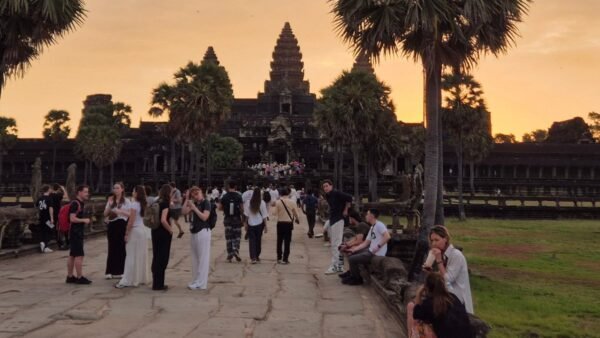
By mid-morning, the temperature alone starts to take a toll. By afternoon, it becomes difficult to sustain any real level of energy or focus, and what initially feels immersive begins to narrow into something more functional. You are no longer taking in the space. You are moving through it.
This is where the mismatch happens. Siem Reap is easy. Angkor Wat is not.
And when both are compressed into a short stay, the ease of one is overshadowed by the intensity of the other — a pattern that shows up again in Kyoto Is Revered — but It Operates on Stricter Terms, where what appears calm and culturally rich quickly becomes demanding once you are moving through it on the ground.
The Mistake Is Trying to “Complete” Angkor Wat in 1 or 2 Days
Most standard tours are built around a one- or two-day structure.
That framework creates a very specific kind of behaviour. You move from temple to temple with the underlying goal of seeing as much as possible within a fixed window, and the pace is not set by your energy but by the itinerary itself. There is an unspoken pressure to “cover” Angkor Wat, as if it were something that can be completed in 2 days.
What ends up happening instead is a form of compression. You wake early, move quickly, stay out longer than you should, and push through heat and fatigue because the structure leaves little room to do otherwise. The effort accumulates quietly at first, then all at once. By the end of it, you have seen a lot, but you have also narrowed the experience down to movement and completion, rather than presence.
This is not a problem with Angkor Wat itself. It is a problem with how it is packaged and consumed.
How to Structure Angkor Wat Without Burning Out
The shift is simple, but it requires letting go of the idea that you need to see everything.
Angkor Wat entry passes are structured in tiers — typically 1-day, 3-day, or 7-day passes — and this alone tells you how the site is meant to be approached. The shorter formats push you toward compression. The longer passes assume that you will need space, not just to see more, but to absorb less at any one time.
Structuring your visit differently usually means stepping away from standard group tours. Instead of following a fixed itinerary, you can arrange your own driver and, if needed, a guide, and decide how much you want to do each day. What changes is not just the schedule, but the logic behind it. You are no longer trying to maximise coverage. You are deciding when enough is enough.
This gives you control over timing, pacing, and when to stop — something that connects directly to Why Your Arrival Time Matters More Than Your Flight Length, because how and when you enter a place shapes everything that follows.
The most effective rhythm is to focus on mornings and late afternoons, and leave the middle of the day out entirely. This is when heat and fatigue peak, and avoiding it changes not just how much you see, but how you experience what you see.
There are still moments worth making the effort for. Sunrise at Angkor Wat is one of them. But it comes with its own trade-offs. Walking through the complex at 4am in the dark, often with only a torchlight, shifts the experience before it even begins. The ground is uneven, visibility is limited, and you are navigating the space before you have had time to orient yourself. It is not just about getting there early, but about being aware of the conditions you are stepping into.
Once you stop trying to “complete” Angkor Wat and instead build your own structure around it, the experience becomes far more manageable and far more coherent.
What Most People Miss About Safety and Physical Access
There is a physical side to Angkor Wat that is often understated.
The steps at certain temples are steep, uneven, and in many cases, without railings. Going up requires effort. Coming down requires a different kind of attention. It is not just about fitness, but about stability, footing, and how confident you feel in your own movement.
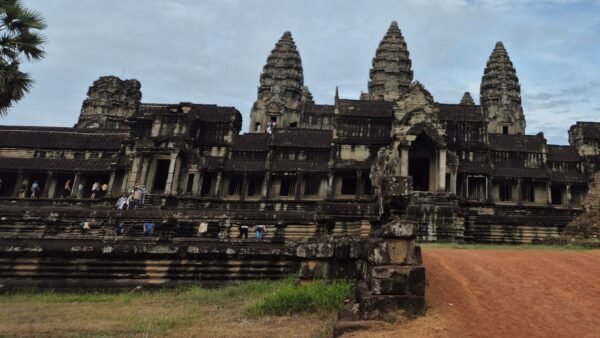
For many travellers, especially those who are no longer comfortable with height or uneven surfaces, this becomes a quiet constraint. It is not always obvious at the start, but it shapes what you can access, how long you can stay, and how much you are willing to push.
On a small group tour I was on, an older man pushed himself hard on the first day, determined to keep up with the pace. By the second day, he could no longer walk and had to seek medical assistance. It was not a dramatic moment at the time, but it shifted the tone of the group. What had felt manageable the day before suddenly had a cost.
On one of the temples — Bayon Temple — this showed up more directly. The steps were steeper than I was comfortable with, and the footing uncertain enough that the tour guide suggested I sit that section out rather than continue through the interior with the group. I stayed around the outer areas instead. I could still see the scale of the structure, the carved faces, and how the temple sits within Angkor Thom, but the experience was partial, shaped by the conditions rather than by choice.
It is best to know your limits early, rather than discovering them halfway through — something that often becomes obvious in The First 24 Hours of Solo Travel: Where Most Mistakes Happen, when early decisions set the tone for everything that follows.
There Is More to Siem Reap Than Angkor Wat
Once you step away from Angkor, Siem Reap opens up in a different way.
The city slows down in the evening
The night markets shift the rhythm of the day. After the intensity of temples, the city contracts into something more contained and walkable. You are no longer moving between sites. You are drifting. The lighting is softer, the pace is unstructured, and the decisions you make — what to eat, where to sit, whether to keep walking — no longer carry consequence.
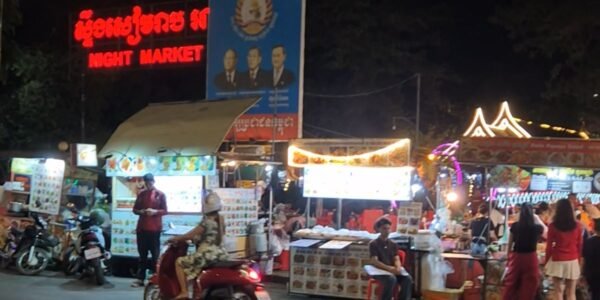
It is not about the markets themselves. It is about what they allow. You can move without a plan, without heat, without distance shaping your choices. That alone changes how the place feels.
Culture becomes something you can sit with
Cultural performances offer a different way of engaging with Cambodia, one that does not require physical effort. At Phare The Cambodian Circus, the storytelling is immediate and contemporary, but grounded in history. It holds your attention without asking anything from you physically.
Traditional Apsara dance performances operate differently. They are slower, more deliberate, and less about narrative progression than presence. You are not moving through a site. You are sitting with it.
Both experiences remove the need to interpret space through movement, which is what makes them effective after Angkor.
Context becomes easier to absorb
The Angkor National Museum provides another layer, but in a controlled environment. Information is structured, air-conditioned, and presented in a way that does not compete with physical fatigue.
It is not essential before Angkor, and in many ways, it works better after. Once you have already seen the temples, the context begins to attach itself to something real rather than abstract.
The city works when you let it fill the gaps
There are also smaller, less structured ways the city reveals itself. Cafés that hold you longer than expected. Spa and massage spaces that allow your body to recover from the physical strain of temple visits. Short walks along the river where nothing in particular is happening, but the absence of demand is the point.
These are not headline attractions, and that is precisely why they matter. They do not compete for your attention. They restore it.
These are not substitutes for Angkor. They are what balance it.
Without them, the entire experience becomes too narrow, shaped entirely by effort and completion. With them, Siem Reap expands back into a place you can inhabit, even if only briefly.
That distinction becomes clearer again when you move into Phnom Penh Takes More Effort Than It Rewards, where the city itself depends heavily on where you choose to stay.
Siem Reap Works — But Only If You Let It Breathe
Siem Reap is not a difficult place.
What makes it feel difficult is not the city itself, but the way most trips are constructed around it. The structure is usually set before you arrive — fixed days, fixed routes, fixed expectations of what needs to be seen — and once you are inside that structure, there is very little room to adjust.
The city does not resist you. It accommodates you. But that accommodation only works if you allow space for it to take effect.
It is easy to settle into, easy to move through, and easy to extend without effort. The environment supports continuity. What disrupts that continuity is the compression of Angkor into something that demands completion rather than experience.
Once you give Angkor space, something else begins to emerge. The temples are no longer something you push through, and the city is no longer something you pass through. The two stop competing with each other.
And when that happens, Siem Reap shifts from being a base into something more stable — a place that can hold your time without requiring constant output from you.
That shift tends to stay with you.
Because once you start paying attention to how a place actually operates — how it distributes effort, where it places demand, and what it allows you to recover — you begin to recognise the same patterns elsewhere, just expressed differently.
It shows up again in Luang Prabang Doesn’t Try To Be More Than It Is, where the structure is less visible, but the consequence is the same: the experience only holds together when you stop trying to impose pace on something that was never designed to carry it.
Travel Logistics Planner
A simple framework for thinking through the logistical side of travel — flights, entry requirements, accommodation and transfers — before the journey begins.
Delivered instantly. Occasional thoughtful updates from the road.