Six Hotels, One Route Through Japan
Six hotels, six weeks, one route through Japan — and only two of them earned a return visit.
The route ran Tokyo, Takayama, Nagoya, Hiroshima, Fukuoka, Sapporo. I booked the lowest available room rate at every single one, the way I always do. From there, Accor Diamond and IHG Platinum status added whatever came with the room on the night: an upgrade when one was available, breakfast included at every stop, and at the two IHG hotels, access to an executive lounge.
Each hotel below is scored against the same eleven-category framework: bed, bathroom, working desk, location, transport, restaurant and breakfast, pool, executive lounge, room upgrades, price tier, and return-guest value. Two of those categories, executive lounge and room upgrades, carry an asterisk. Both depend on holding top-tier status with the relevant programme — Accor Diamond or IHG Platinum Elite. A member on a lower tier books the same room at the same hotel and simply isn’t offered either one, so those two scores reflect what top-tier status unlocks, not what every guest can expect. The Overall Score is a plain average across all eleven categories, asterisked scores included.
I’ve written before about why the system matters more than the city list. That logic starts here, with the same discipline that runs through this whole trip: Planning a Japan Trip? Start With the System, Not the Cities.
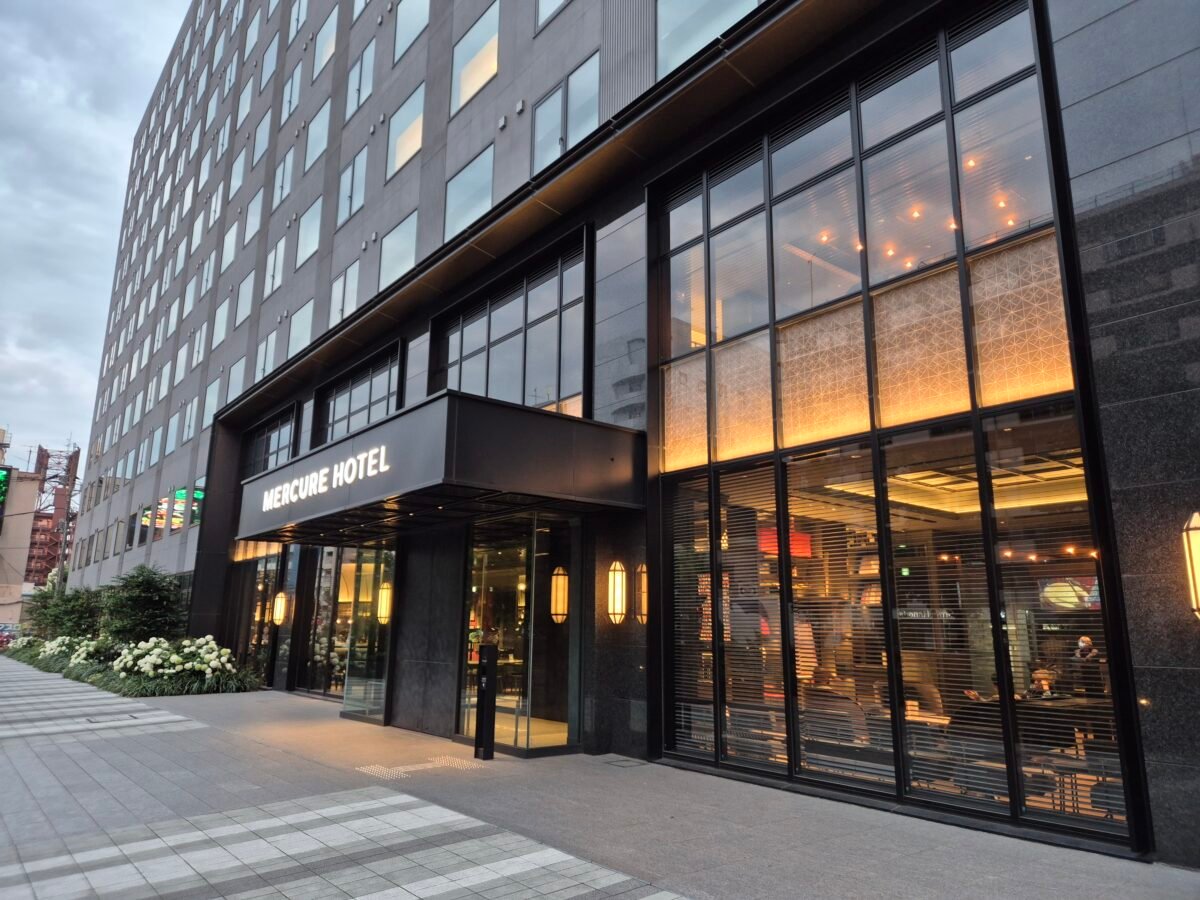
Mercure Tokyo Haneda Airport (Accor)
Overall Score: 3.9 / 5
Mercure Tokyo Haneda Airport sits three minutes on foot from Otorii Station’s east exit. Stairs lead down to the platform, though an escalator carries you back up. From Otorii, the subway reaches all three Haneda terminals in about eight minutes, and it runs direct to Shinagawa, a major Shinkansen terminal, in fifteen.
Shinagawa handles transfers more easily than Tokyo Station does, and the difference is worth knowing before you land. Tokyo Station is enormous, spread across multiple levels with a long walk between the Shinkansen gates and the JR lines that feed into them, and first-time visitors often lose ten or fifteen minutes just finding the right platform. Shinagawa is smaller and laid out more directly, so a transfer there costs far less time and far fewer wrong turns.
The hotel runs a free shuttle to Haneda, but its timetable didn’t line up with my arrival, so I took a taxi from the rank instead, eleven minutes by car. If you’re already carrying an IC card, the subway route from the airport to Otorii, then on foot to the hotel, is straightforward.
The Room, the Price, and Why It Works
I was upgraded here, as I always book the lowest available room rate and let status take it from there. The hotel is new, modern, and unmistakably Japanese in its restraint, and breakfast, included through status, was genuinely good. From Otorii, central Tokyo opens up fast: Ginza in thirty-three minutes, Shinjuku in forty-one, Shibuya in thirty-five, Ueno in thirty-seven, and Yokohama runs direct in twenty-two minutes with no transfers required. Tokyo itself can feel overwhelming to a first-time visitor, something I’ve written about in Why Tokyo Feels Overwhelming — and Why It’s Not, but staying out at Otorii kept me close enough to reach the centre in minutes without ever feeling like I was in the thick of it.
Staff speak excellent English, and the area around the hotel does real work for a traveller. A 7-Eleven and a drug store sit directly opposite, a handful of reasonably priced restaurants are close by, and a coin laundry is seven minutes on foot. Mercure Haneda undercuts most hotels inside Tokyo proper, including Ibis, Accor’s own budget brand, which says something about how pricing actually works in this city. I wasn’t trying to be in the centre of everything. I was trying to move through it efficiently, and this hotel let me do exactly that.
Luggage Forwarding
Luggage forwarding here runs through Sagawa: the hotel hands you a QR code, you arrange and pay directly with Sagawa online, and at checkout you present the code, hand over your case, and collect a receipt. I’ve laid out the full system behind that arrangement, including why I skipped forwarding to Takayama and Sapporo altogether, in Luggage Forwarding in Japan: A Real Multi-City Route.
Score card
| Category | Score | Notes |
|---|---|---|
| Bed | 5.0 | |
| Bathroom | 5.0 | |
| Working Desk | 5.0 | |
| Location | 5.0 | |
| Transport | 5.0 | |
| Restaurant & Breakfast | 5.0 | |
| Pool | 0.0 | No pool |
| Executive Lounge* | 0.0 | No executive lounge |
| Room Upgrades* | 5.0 | |
| Price Tier | 3.0 | |
| Return-Guest Value | 5.0 |
*Reflects top-tier loyalty status — Accor Diamond or IHG Platinum Elite. Members on a lower tier may not have access to this benefit.
Mercure Takayama (Accor)
Overall Score: 3.5 / 5
From Haneda, the loop continued to Takayama. Mercure Takayama is three minutes on foot from Takayama Station, where the Hida Limited Express pulls in and a local train continues on to Hida Furukawa for a day trip.
I was upgraded again, same lowest-rate booking, same result. The hotel carries the same restrained, modern aesthetic as Haneda, and breakfast, included through status, was excellent. Staff speak reasonable English, competent rather than fluent.
Restaurants sit near the hotel, though there aren’t many of them, and the ones closer to the old town are a twelve-minute walk. The nearest 7-Eleven is five minutes away. Mercure Takayama isn’t cheap, and its prices swing hard with the season.
I didn’t use the hotel’s luggage forwarding here. My case was already routed from Tokyo straight through to Nagoya, bypassing Takayama entirely, part of the same skip-and-hold system I’ve written about separately. There’s an onsen on site too, though I didn’t use it. Onsen culture isn’t my lane, and this trip wasn’t about testing it.
Score card
| Category | Score | Notes |
|---|---|---|
| Bed | 5.0 | |
| Bathroom | 5.0 | |
| Working Desk | 5.0 | |
| Location | 4.0 | Marked down a bit because of the distance to the town centre |
| Transport | 5.0 | |
| Restaurant & Breakfast | 5.0 | |
| Pool | 0.0 | No pool |
| Executive Lounge* | 0.0 | No executive lounge |
| Room Upgrades* | 5.0 | |
| Price Tier | 1.0 | Prices fluctuate wildly by season |
| Return-Guest Value | 3.0 | Because of price, not the quality of the hotel |
*Reflects top-tier loyalty status — Accor Diamond or IHG Platinum Elite. Members on a lower tier may not have access to this benefit.
Ibis Styles Nagoya (Accor)
Overall Score: 2.7 / 5
From Takayama, the loop continued to Nagoya. The two cities work as a single base in my system, something I’ve laid out fully in Where to Base Yourself in Central Japan: Nagoya and Takayama. Ibis Styles Nagoya is nine minutes on foot from Nagoya Station, the city’s major Shinkansen and subway hub, though I didn’t use that station for everyday movement around the city. The closer option is Kokusai Center Station, five minutes’ walk from the hotel, and that’s the one I relied on day to day. Nagoya Station came into play for two specific things instead: catching the Meguru sightseeing loop bus, and taking the subway out to Atsuta Shrine.
I was upgraded here too, though it’s worth setting expectations correctly: this is a basic Ibis, and Accor’s budget tier behaves like one. Staff speak reasonable English, but breakfast was very poor, easily the weakest of the whole trip, and there’s no working desk in the room either. Reception doesn’t offer much seating to make up for it, which is a real gap if you’re trying to get anything done.
I forwarded my luggage from here through to Fukuoka, bypassing Hiroshima entirely, arranged directly through reception — the alternate-city method I’ve written about in Luggage Forwarding in Japan: A Real Multi-City Route. And I paid almost nothing for the room itself, having burned points to book it, which is its own kind of value even with the breakfast working against it.
Score card
| Category | Score | Notes |
|---|---|---|
| Bed | 5.0 | |
| Bathroom | 5.0 | |
| Working Desk | 0.0 | No working desk; limited reception seating |
| Location | 5.0 | 5-minute walk to Kokusai Center Station for everyday transit; 9-minute walk to Nagoya Station for the Meguru bus and the Atsuta Shrine subway line |
| Transport | 5.0 | |
| Restaurant & Breakfast | 1.0 | Breakfast quality was very poor |
| Pool | 0.0 | No pool |
| Executive Lounge* | 0.0 | No executive lounge |
| Room Upgrades* | 3.0 | |
| Price Tier | 5.0 | Booked on points, essentially free |
| Return-Guest Value | 1.0 | Poor breakfast and no working desk |
*Reflects top-tier loyalty status — Accor Diamond or IHG Platinum Elite. Members on a lower tier may not have access to this benefit.
ANA Crowne Plaza Hiroshima (IHG)
Overall Score: 4.5 / 5
From Nagoya, the loop continued to Hiroshima. ANA Crowne Plaza Hiroshima isn’t within walking distance of Hiroshima Station, but that barely registers — buses and trams stop directly outside, and the JR-operated Meipuru-pu tourist loop bus, running lemon, green, and orange routes, stops at Namiki-dori-iriguchi, four minutes on foot from the hotel.
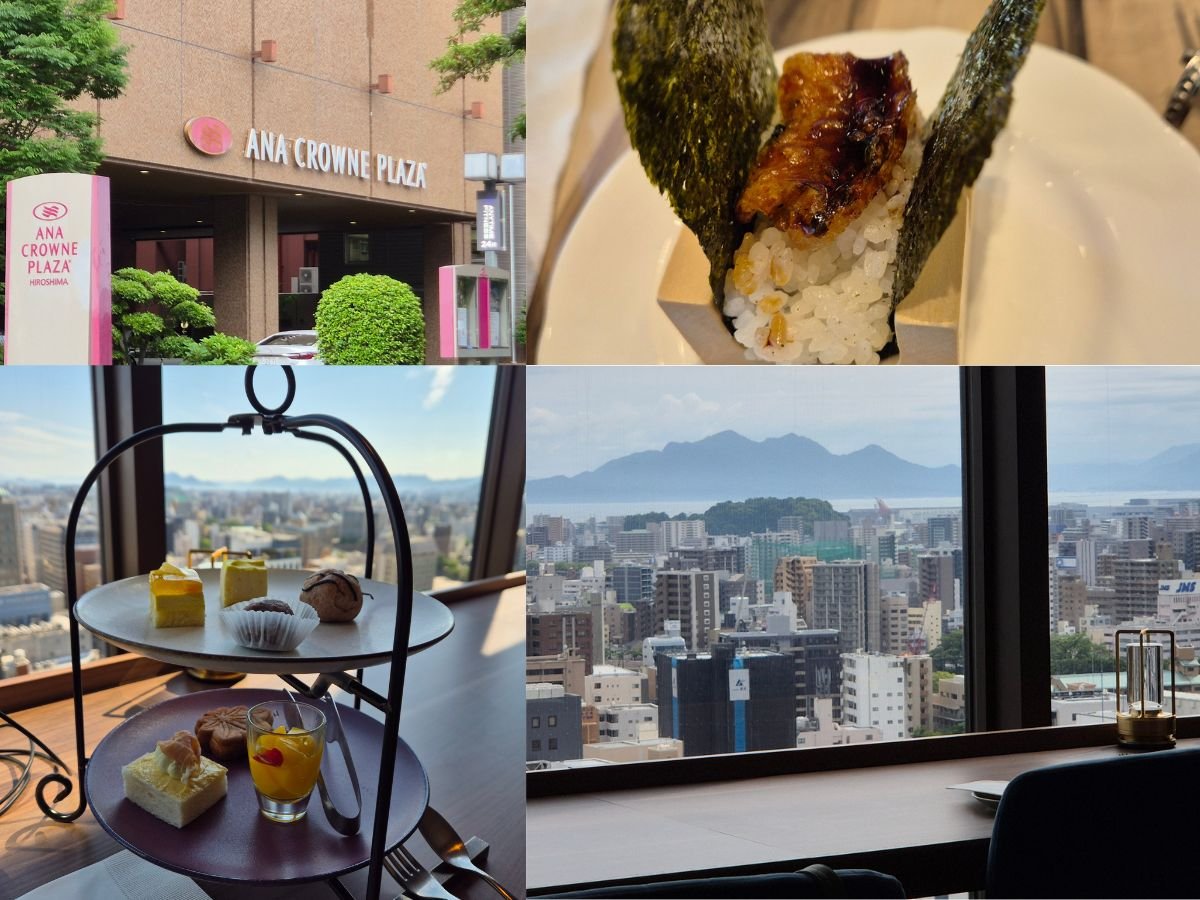
I was upgraded here as well, lowest rate booked as always, and this is where the loop’s status economics actually paid off. Breakfast came with three separate options — the all-day restaurant, the executive lounge, and a dedicated Japanese restaurant — and staff speak excellent English throughout.
A Family Mart sits on the ground floor of the hotel itself, a drug store is two minutes away, and the coin laundry I used is five minutes on foot. The executive lounge pours unlimited sake, and while the evening food offering is limited to canapés, the lounge itself is genuinely one of the better places I’ve worked from on this trip.
I’ve written separately about why this city earned a place among my favourites in Japan — the hotel is part of that case, not incidental to it: Why Hiroshima Became One of My Favourite Cities in Japan.
Score card
| Category | Score | Notes |
|---|---|---|
| Bed | 5.0 | |
| Bathroom | 5.0 | |
| Working Desk | 5.0 | Both the room and the executive lounge |
| Location | 5.0 | Close to all main sights, walkable |
| Transport | 5.0 | |
| Restaurant & Breakfast | 5.0 | |
| Pool | 0.0 | Extra charge to use the pool |
| Executive Lounge* | 5.0 | |
| Room Upgrades* | 5.0 | |
| Price Tier | 5.0 | Reasonable for the value it provides |
| Return-Guest Value | 5.0 |
*Reflects top-tier loyalty status — Accor Diamond or IHG Platinum Elite. Members on a lower tier may not have access to this benefit.
ANA Crowne Plaza Fukuoka (IHG)
Overall Score: 2.8 / 5
From Hiroshima, the route continued to Fukuoka. ANA Crowne Plaza Fukuoka sits five minutes on foot from Hakata Station, another major Shinkansen hub with shopping, restaurants, and a large bus terminal attached. On paper, the location matches Hiroshima’s. In practice, almost nothing else did.
I was upgraded here too, but the hotel is old and dated, and it shows. The bathroom isn’t disability-friendly — there are unexpected steps that catch you off guard, and I actually fell in there during my stay. Staff speak reasonable English, and the surrounding area is central and well served by restaurants, so the location itself isn’t where this hotel loses points.
The hotel only provided breakfast at the executive lounge, with no option to eat in the all-day restaurant the way Hiroshima offered across three separate venues. The evening food in the lounge was a step up from Hiroshima’s canapés, but it still didn’t amount to a full meal. I ended up working from the lounge rather than the room, mostly because the room itself was depressing enough that I didn’t want to spend time in it.
Luggage forwarding here worked the same way it had at Nagoya: reception arranged everything on my behalf, and the charge appeared on my hotel bill. The case skipped straight past Sapporo and met me back in Tokyo, the same alternate-city method I’ve written about in Luggage Forwarding in Japan: A Real Multi-City Route.
Same programme, same hotel brand, same booking discipline as Hiroshima — and a completely different result. That gap is the whole point of scoring hotels individually instead of trusting a brand name to carry the value.
Score card
| Category | Score | Notes |
|---|---|---|
| Bed | 4.0 | |
| Bathroom | 1.0 | Unexpected steps; not disability-friendly, and I fell |
| Working Desk | 3.0 | Executive lounge only |
| Location | 5.0 | Close to all main sights, walkable |
| Transport | 5.0 | |
| Restaurant & Breakfast | 5.0 | Exec lounge only |
| Pool | 0.0 | |
| Executive Lounge* | 5.0 | |
| Room Upgrades* | 2.0 | |
| Price Tier | 1.0 | Very expensive for what it offers |
| Return-Guest Value | 0.0 | Not going back |
*Reflects top-tier loyalty status — Accor Diamond or IHG Platinum Elite. Members on a lower tier may not have access to this benefit.
Grand Mercure Sapporo (Accor)
Overall Score: 3.5 / 5
The loop’s final stop was Sapporo, and Grand Mercure Sapporo carried the highest location friction of the entire trip. The route ran a flight from Fukuoka, a train from Sapporo airport to Sapporo Station, then a taxi to the hotel itself — Sapporo Station, at least, is a major hub with shopping and restaurants attached.
Status upgraded the room here too, but the hotel itself is old, dated, and felt almost like a ghost town. Guests are expected to collect their own water from a central dispenser in the corridor, an odd touch for a hotel that isn’t budget-tier. Staff speak reasonable English, and with the hotel sitting away from the centre and few restaurants nearby, I relied on convenience stores for dinner across all four nights of the stay. The hotel’s own restaurant wasn’t even open in the evenings, so that wasn’t an option either.
Executive Lounge and Breakfast
The executive lounge is folded into the restaurant rather than run as its own space, despite the hotel having plenty of empty rooms to work with. The food offering there was poor enough that I went once and didn’t go back.
Breakfast is what saves this hotel, and it isn’t close. This was the best and best-value breakfast I had anywhere in Japan — unlimited tuna and salmon sashimi every morning, alongside a genuinely large spread of Japanese and Western dishes. It doesn’t make up for the location, but it’s worth knowing about if you end up here anyway.
Would I Go Back?
I won’t be back at Grand Mercure Sapporo. If I return to the city at all, I’d try Mercure Sapporo instead — a separate property I haven’t stayed at, with a more central location than the one I reviewed here. What’s putting me off a second visit to Sapporo isn’t really either hotel. It’s the friction of getting there in the first place.
Score card
| Category | Score | Notes |
|---|---|---|
| Bed | 5.0 | |
| Bathroom | 5.0 | |
| Working Desk | 5.0 | |
| Location | 2.0 | |
| Transport | 4.0 | Subway station nearby; taxis available |
| Restaurant & Breakfast | 5.0 | Best breakfast of the whole trip |
| Pool | 0.0 | |
| Executive Lounge* | 1.0 | Folded into the restaurant; poor food offering |
| Room Upgrades* | 5.0 | |
| Price Tier | 5.0 | Very cheap, and now I know why |
| Return-Guest Value | 1.0 | Not going back; location too far from restaurants |
*Reflects top-tier loyalty status — Accor Diamond or IHG Platinum Elite. Members on a lower tier may not have access to this benefit.
What the Loop Actually Taught Me
Six hotels, one consistent booking discipline: always the lowest published rate, with status adding whatever came with it — an upgrade, breakfast, lounge access where the brand offered one. That’s the actual finding here. Status didn’t create quality. It amplified whatever quality already existed underneath it.
At Hiroshima, that meant three breakfast venues and an executive lounge worth working from. At Fukuoka, the same programme and the same hotel brand meant free access to a lounge attached to a room I didn’t want to spend time in. At Sapporo, the pattern flipped the other way: a genuinely excellent breakfast couldn’t offset a location that left me eating convenience-store dinners for four nights straight.
That’s the frictionless part of this system that rarely gets said out loud. The goal was never the upgrade. It was never having to think about breakfast, or the working desk, or whether the executive lounge would be worth the walk down the corridor. Get the hotel right, and status quietly compounds every other decision behind it. Get it wrong, and no amount of status closes that gap — Fukuoka proved that on this loop. Sapporo showed the same thing from a different angle: even a hotel that mostly gets it right can’t outrun a location that fights you before you’ve even checked in.