
I’ve done Japan twice, eight years apart, and the two trips could not have gone more differently. The first ran three weeks with a friend, and friction started before we’d even left the airport. Landing after a long-haul flight, we had to sort out the JR Pass on the spot, since that was how we’d planned to reach Shinjuku. Our own luggage came with us the whole way: through the exchange counter, onto a transfer at a busy Tokyo station, and into Shinjuku, busier still, where we promptly got lost.
It was already late at night by the time we found our way out, and that was just the first day. The rest of the trip ran on the same pattern. Problems got solved on the spot, because none of today’s infrastructure existed yet to solve them in advance, and by the end the fatigue and frustration had built up in a way that had nothing to do with Japan itself and everything to do with how little support was running underneath the trip.
The second time ran forty days, entirely alone, and it was close to frictionless. The one thing the system couldn’t help was my body: a health issue that built quietly and no amount of planning could have prevented. Everything else — where I slept, how my luggage moved, how I read a platform, how I paid for a train — simply worked, because none of it was left to chance the way it had been the first time.
This isn’t a piece about which itinerary to copy. It’s the blueprint I didn’t have the first time and built by the second: the decisions that hold regardless of which cities you choose, and what changes once you actually apply them to the route you’re taking.
The System I Run Now, Wherever I’m Going
The approach isn’t specific to Japan: a hotel base built on status, a digital layer sorted before landing, pacing designed in advance rather than left to chance. That much travels with me everywhere. What changes country to country is which tools are actually available to run it. Japan offers two things most countries don’t: a luggage forwarding network reliable enough to build an entire route around, and a transit card that works as payment everywhere, not just on trains and buses. Here’s what the system actually involves, Japan-specific tools included.
A Hotel Base You’ve Actually Earned
Every hotel I book in Japan comes from one of two loyalty programmes, Accor or IHG. I hold Diamond with Accor and Platinum with IHG, and neither status happened by accident. Both came from booking deliberately, stay after stay, since I sold the house and moved into hotels full time, which became its own story: Why I Sold My House and Live In Hotels Instead.

What Accor Diamond Actually Gets You
Accor Diamond gets me daily breakfast at properties across Asia Pacific and Executive Lounge access as standard. Upgrades are where it actually shows: I consistently get moved up even when I’ve booked the lowest rate available, and every so often that turns into a full suite, unprompted. There’s also a quieter benefit that doesn’t show up on any benefits chart: a sense of familiarity walking into a hotel as a recognised member, rather than as a stranger starting from zero each time.
Where IHG Platinum Gets Inconsistent
IHG Platinum offers something similar in theory, but in practice the inconsistency shows up specifically around breakfast, and it comes down to the individual hotel rather than the programme itself. At the Crowne Plaza Hiroshima, Platinum status opened every venue serving breakfast: the all-day restaurant, the executive lounge, and the Japanese restaurant.
The Crowne Plaza Fukuoka, same brand, same country, same status, opened only the executive lounge and nowhere else. It’s the luck of the draw, and you don’t know which version you’ll get until you check in. IHG Diamond removes that uncertainty — breakfast in the executive lounge and the all-day restaurant comes standard — which is one more reason reaching it is worth the push.
That hotel-by-hotel unpredictability at Platinum is the main reason I favour Accor over IHG when I have a genuine choice between them. Where IHG wins in Japan specifically is footprint: more properties, in more convenient locations across Japanese cities, than Accor currently has.
What a Private Rental Can’t Give You
I don’t book Airbnbs in Japan or anywhere else, and two years of staying exclusively in hotels means I’ve simply stopped dealing with an entire category of problems that comes standard with a private rental. There’s no self-check-in code to hunt for after a long flight, no lockbox that won’t open, no host to coordinate with by message before you can actually get inside. If something breaks in the room, nobody’s downstairs to fix it; you’re waiting on a reply that might not come for hours.
Every stay works the same way the last one did, instead of starting from zero with someone else’s instructions each time. None of that is infrastructure you can simply buy on a private rental. You either build it yourself, city by city, spending effort and energy replacing what a status account already provides, or you accept the friction as the cost of the lower price.
The Digital Layer, Sorted Before You Land
Everything digital gets sorted before the plane lands, not after: an Airalo eSIM, a VPN running by default, multi-factor authentication that doesn’t rely on a single point of failure, and document backups marked for offline access. Google Maps handles navigation on foot and, especially, on the trains, reading platforms and transfers well enough to be the backbone of getting around. For taxis, I run both GO and Uber, though Uber is the one I actually prefer; the technology is simply better.
Visit Japan Web is the government’s online immigration and customs declaration, completed before you fly and replacing the paper arrival card entirely. It generates a single QR code covering both, checked once at immigration and again at the exit gate after baggage claim. The full setup is in Digital Apps, eSIM, VPN: Sorted Before I Land in Japan.
AI is part of this too, though not the way most people mean when they bring up AI and travel. I don’t use it to plan the trip. I use it on the ground, after I’ve landed, for what a phrasebook or a guidebook can’t do in real time: photographing a sign, a menu, or a departure board and asking what it says, then what to do about it. That’s what got me through a fifteen-minute connection window at Nagoya with no margin for error. That case, and the difference between planning with it and actually using it, is the subject of Forget AI Itineraries: What Actually Helps Solo Travellers.
One Transit Card, Used Everywhere
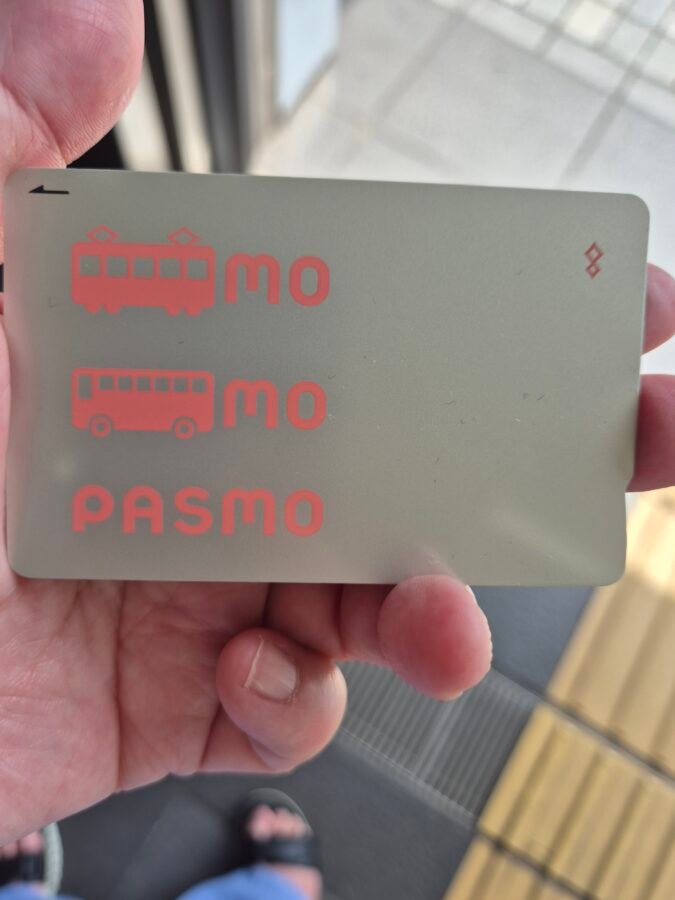
One IC card — Pasmo, though Suica or any of the others work the same way — covered trains and buses across every city on the route, and paid for convenience store snacks, vending machine drinks, and coin lockers just as easily. Topping up isn’t limited to station machines either; convenience store counters work anywhere in the country, which mattered in Takayama specifically, where the station itself had no machine at all. How all of that actually works is in The Transit Card You Need for Public Transport in Japan.
Luggage That Moves Without You Carrying It
On the second trip, a single Muji backpack, seven kilograms, carried me between six cities while a twenty-two kilogram suitcase travelled separately. Japan’s forwarding network holds a bag for up to seven days at no extra charge, and that hold window is what let me bypass delivery to three cities entirely: Takayama, Hiroshima, and Sapporo. The suitcase simply routed around them and met me further down the line. Real mechanics, actual per-leg costs — all of it’s in Luggage Forwarding in Japan: A Real Multi-City Route. It’s the single biggest physical difference between the two trips.
Sequencing Your Cities With the Shinkansen’s Flow
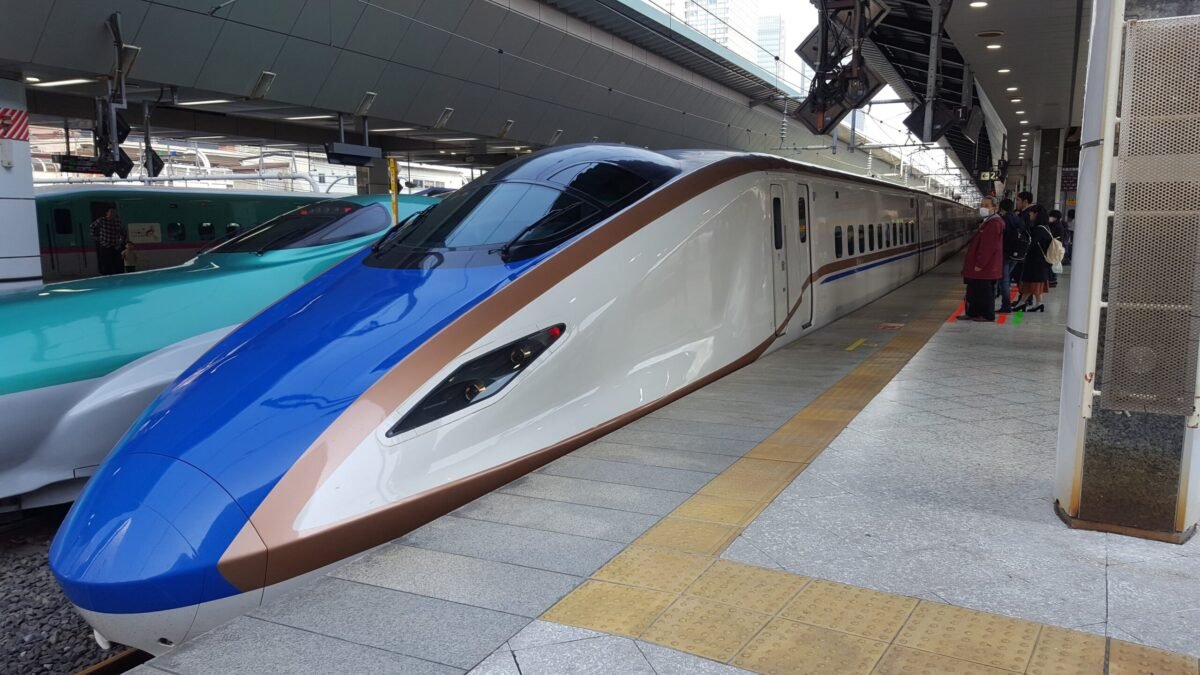
The shinkansen network has a grain, and it’s easy to fight it without realising. The fastest services, Nozomi and Mizuho, aren’t covered by a JR Pass, so pass holders ride Hikari instead, which runs a little slower and sometimes splits its run partway through a longer journey. On my Nagoya to Hiroshima leg, that meant changing trains at Kobe — an easy change, since the connecting train waited on the same platform. Nozomi runs the identical route without ever splitting; choosing it would have meant no change at all.
Whether that grain works in your favour also decides whether a JR Pass is worth the money. I paid AUD 890 for a twenty-one day pass on the second trip. The legs I actually rode, priced individually with a reserved seat on every one, added up to AUD 616. Completing every day trip I’d originally planned would only have saved about AUD 77 over buying tickets separately.
A health issue that built quietly from Seoul onward cost me most of those day trips, and once they were gone, so was the pass’s entire case. The full numbers are in Why I Won’t Buy The JR Pass Again. Next time, I’ll book each shinkansen leg as I need it instead and pay for exactly the trip I actually take.
Pacing Isn’t an Afterthought
Arrival day runs on its own rule, the same one I use everywhere, not just Japan. Where I can choose it, I land during daylight. I don’t do any admin the moment I’m through immigration: no cash, no transit card, nothing that can wait until morning. Getting out of the airport and into the hotel has to be fast and require no decisions, which means relying on a credit card, whether that’s a pre-booked private transfer or a taxi from a rank I already know takes cards, the way I did at Haneda.
I hadn’t even collected the JR Pass I’d booked by the time I reached the hotel that first night; it waited, same as everything else. Cash and a transit card come the next morning, after sleep, not before. More on why the hour you land matters in Why Your Arrival Time Matters More Than Flight Length, and on the rest of that first day in The First 24 Hours of Solo Travel: Where Most Mistakes Happen.
The base itself works the same way. Five nights in one place is where a base actually starts to function as one, and Hiroshima, at six nights against the two most guides recommend, is exactly that: a base the shinkansen turns into a launchpad for day trips like Himeji, rather than another city to pack up and leave. Leg trouble meant I didn’t reach everywhere I’d planned from there, but the model itself held regardless. Stay put, let the trains do the moving, and a day trip becomes something you add to a stable base, not a new relocation each time. That argument gets made in full in Why Changing Accommodation Too Often Is More Exhausting Than Long Travel Days.
The Golden Route
My first Japan trip ran the golden route: Tokyo, Kanazawa, Kyoto, Nara, Osaka, and back to Tokyo, eight years ago now. Three weeks, travelling with a friend. None of the system above existed for either of us yet. We stayed in Airbnbs the whole way through, one hotel in Nara aside, and none of today’s infrastructure was there to remove the friction that came up along the way.
Tokyo — First Impressions
My first night in Tokyo, a friend and I spent close to two hours working our way through Shinjuku Station’s underground maze, unable to find the exit that would put us anywhere near our Airbnb, while our host waited outside in the dark. It didn’t put me off. If anything, it was the start of something I’ve kept coming back to. Why Tokyo provokes that reaction, and why it isn’t the same as the city being difficult, is the subject of Why Tokyo Feels Overwhelming — and Why It’s Not, with the practical side covered separately in Tokyo Practical Guide: What to Expect and How to Handle It.
Kyoto — Reverence on Stricter Terms
Kyoto asks more of visitors than its reputation lets on. The crowd pressure concentrated into a handful of historic districts, and it compressed harder than Tokyo’s. The full account is in Kyoto Is Revered — but It Operates on Stricter Terms. It’s from eight years ago, though, and I haven’t been back to Kyoto since. Even then, the city was already overrun with tourists, and I can’t imagine what it’s like now.
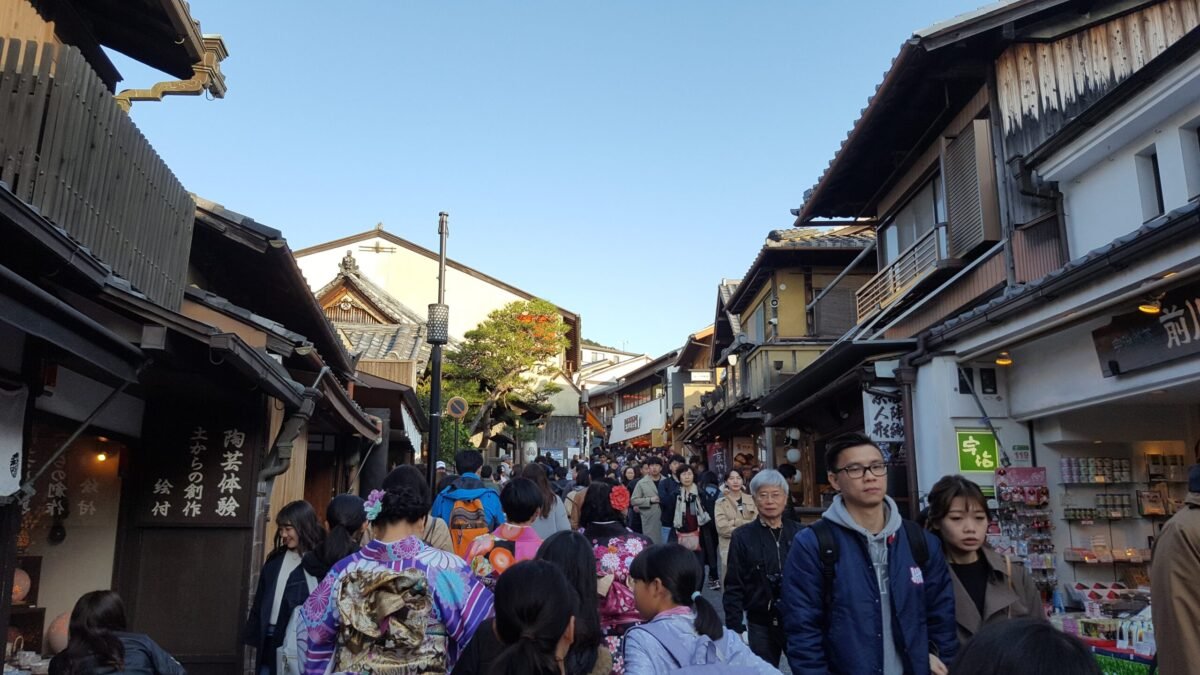
Since April 2024, a handful of Gion’s private alleys, the narrow ones leading to the teahouses, have been off-limits to tourists entirely, with fines of up to ¥10,000 for entering. It followed years of visitors chasing geiko and maiko for photos and wandering onto private property. The main street, Hanamikoji, and the rest of the district remain open; it’s a small, specific area that’s closed, not Gion itself.
None of this means Kyoto isn’t worth going. It means going in with the right expectation: it will take a lot out of you. Give it enough days, including at least one with nothing planned, to actually absorb that, rather than jamming the rest of your itinerary tight around it. Going back doesn’t interest me. There’s so much of Japan I haven’t seen yet, and standing in the tourist herd never held much appeal anyway.
Osaka — Easy, and Still Not a Return
Osaka came last in the loop, after Tokyo and Kyoto had already done the work of orientation, and it landed as a release. Restaurants were built for visitors who don’t speak Japanese — photo menus, point-and-order systems, no hesitation at the door — a direct contrast to what Kyoto had put me through. That ease, and why it didn’t translate into wanting to go back, gets its own piece: Osaka Travel: Why It Feels Easy and Why I Didn’t Return.
What I’d Do Differently on the Golden Route With the System Now
Here’s what actually drives this redesign: almost all of the friction on that first trip traces back to Kyoto. The crowd pressure there was worse than anywhere else on the route, and three weeks with no infrastructure meant nothing was there to absorb it. Everything below follows from that one fact.
Run the golden route again today, and I’d plan it completely differently from the start. I wouldn’t jam the schedule the way we did the first time. Kanazawa would come out of the route entirely, not because it wasn’t worthwhile, but because those days are better spent absorbing Kyoto properly. I wouldn’t loop back to Tokyo for the flight out either; flying into Tokyo and out of Osaka skips the backtrack across the country and frees up even more time for the city that actually needs it.
I’d give Kyoto more time than any other city on the route, with rest built in between. That’s not the system fixing Kyoto — the system only removes the frictions that are actually manageable: the luggage, the admin, the check-ins, the bookings. Kyoto’s crowd pressure isn’t manageable. It’s simply what Kyoto costs, system or no system, and the only real answer is time: enough days to absorb it, and rest days placed inside that time.
A three-week version of this route, run with the system and none of the first trip’s jam-packing, looks like this:
| Days | Base | Nights | Why |
|---|---|---|---|
| 1–7 | Tokyo | 7 | Arrival, orientation, no back tracking |
| 8–14 | Kyoto | 7 | The crowd pressure needs the days, with at least one full rest day mid-stay |
| 15–17 | Nara | 3 | Short and unhurried, pace starts slowing |
| 18–20 | Osaka | 3 | Closing base, easier pace so that you don’t need another holiday after Japan |
| 21 | Depart from Osaka | — |
Beyond the Golden Route
The second trip skipped the golden route almost entirely: no Kyoto, no Osaka, no Nara. Tokyo again, then Takayama, Nagoya, Hiroshima, Fukuoka, and Sapporo, forty days run entirely on the system above.
| Days | Base | Nights | Notes |
|---|---|---|---|
| 1–10 | Tokyo | 10 | Arrival base, Mercure Tokyo Haneda |
| 11–15 | Takayama | 5 | Mercure Takayama — Hida Furukawa day trip |
| 16–20 | Nagoya | 5 | Ibis Styles Nagoya, booked with reward points — Shirakawa-go day trip |
| 21–26 | Hiroshima | 6 | Crowne Plaza Hiroshima — Himeji day trip |
| 27–31 | Fukuoka | 5 | Crowne Plaza Fukuoka — the 21-day JR Pass ran out here |
| 32–35 | Sapporo | 4 | Flown in from Fukuoka on JAL |
| 36–39 | Tokyo | 4 | Closing base, Mercure Tokyo Haneda — flown in from Sapporo on JAL |
| 40 | Depart from Tokyo (Haneda) | — | Flight home — free shuttle from the Mercure Tokyo Haneda |
Both of those last two legs, Fukuoka to Sapporo and Sapporo to Tokyo, were flown on JAL using Qantas points, so neither cost anything beyond the points themselves.
Tokyo, Revisited
I gave Tokyo ten nights at the start of the second trip and another four at the end, based at the Mercure Tokyo Haneda, on the rail network rather than in the thick of downtown. On my last afternoon before flying home, I went looking for a matcha parfait I’d eaten on the last day of my first trip, at a restaurant whose name I’d forgotten. Tokyo Station’s underground layout doesn’t forgive that kind of gap, so I did what I’d done constantly across the whole trip and asked ChatGPT to help track it down. It found Tsujiri. I ordered the same parfait, eight years on, and kept a promise I’d made to myself the first time.
Basing in Nagoya and Takayama
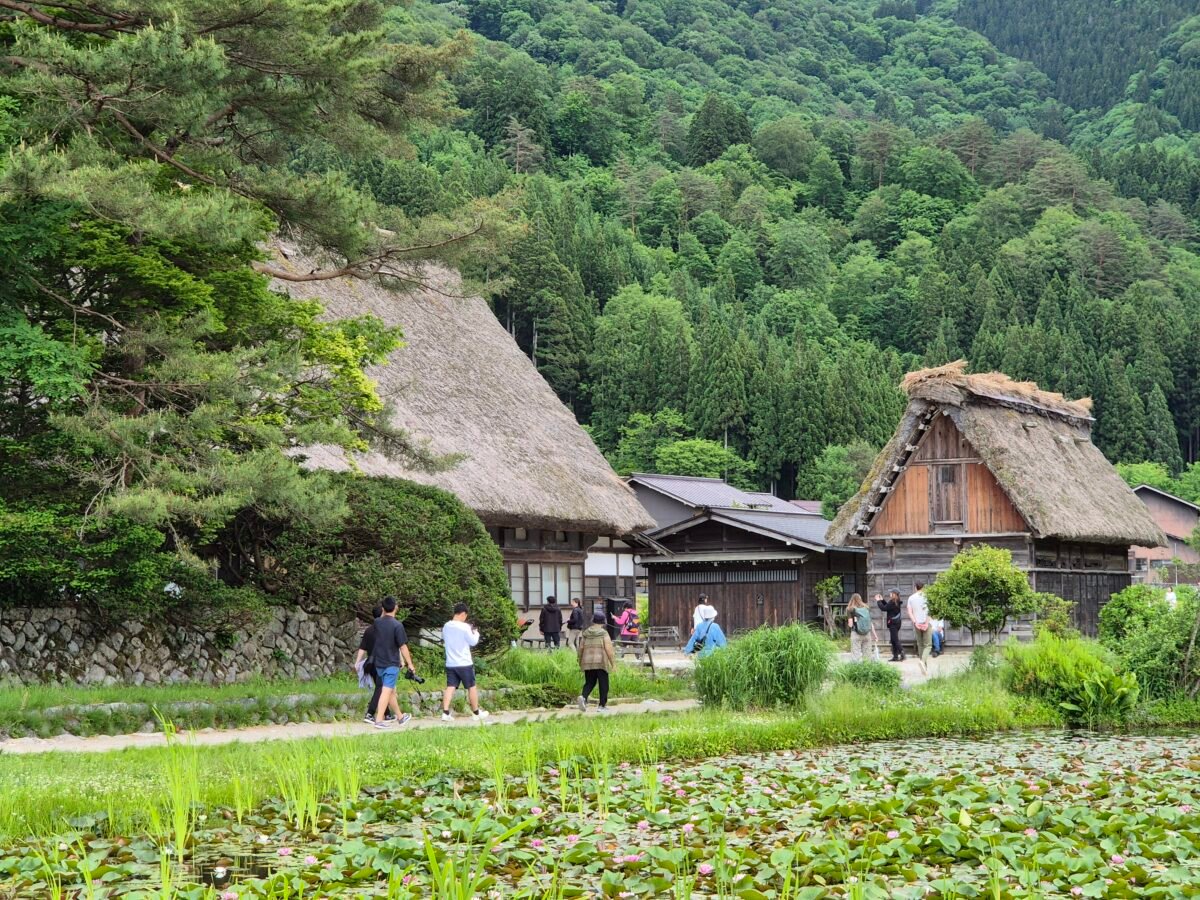
Every guide said not to waste nights in Nagoya and to base in Takayama instead. I did the opposite: five nights in Nagoya at the Ibis Styles, covered with reward points, and five more in Takayama at the Mercure. The Shirakawago plan built around Takayama fell apart before I arrived — the reserved bus seats had sold out, and the tour I’d booked through Klook out of Takayama was cancelled — so I reached Shirakawago on a Klook tour departing from Nagoya instead.
Hida Furukawa, reached independently by train from Takayama, turned out to be the trip’s quiet standout: canals clear enough to watch koi drift through them, and a town most itineraries never mention at all. The full basing logic, including where the original plan broke and how Nagoya’s spare capacity absorbed it, sits in Where to Base Yourself in Central Japan: Nagoya and Takayama.
Hiroshima, and Why Two Days Isn’t Enough
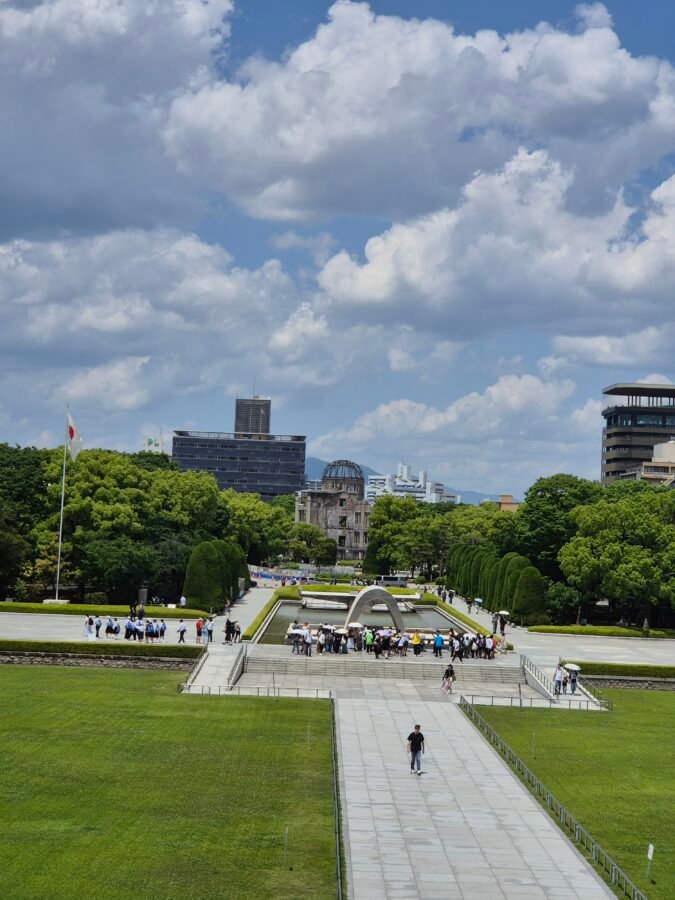
I left Hiroshima off my first trip on purpose. I don’t condone war, and for a long time I had no wish to stand in the place where it reached one of its worst conclusions, so the city stayed off my map by choice. What changed my mind was Oppenheimer. Watching it, I realised avoiding Hiroshima had let me keep the whole thing at a comfortable distance, a fact I knew rather than a place I understood.
That’s when the second trip gave it six nights at the Crowne Plaza, running on IHG Platinum. Four day trips went into the plan around it: Miyajima, Okayama, Himeji, and Fukuyama. I took one, Himeji, and let the other three go. Leg trouble slowed me down that trip, but it alone wouldn’t have cancelled three excursions; the simpler truth is that every morning I found I’d rather stay in Hiroshima than leave it, and eventually I stopped arguing with myself about it. Why the standard two days undersells the city is the subject of Why Hiroshima Became One of My Favourite Cities in Japan.
When to Visit Japan
Prices change a lot depending on when you travel, and that’s true right across Japan. Cherry blossom season and Golden Week are the two most expensive windows of the year everywhere in the country, and hotel rates in those weeks can double or more. If your trip falls inside either window, book earlier than you think you need to.
| Season | When | What to Expect |
|---|---|---|
| Winter off-peak | Mid-January – early March | The cheapest, quietest stretch of the year outside ski regions and Sapporo’s Snow Festival in February |
| Cherry blossom | Late March – early April | The single most expensive and crowded stretch of the year. |
| Golden Week | Late April – early May | A run of national holidays that sends domestic travel surging nationwide |
| Summer | June – August | Hot and humid, with typhoon risk building from August. Obon, mid-August, spikes both domestic travel and prices |
| Autumn foliage | September – November | The second major peak of the year, crowds and prices rivalling cherry blossom season |
| New Year | Late December – early January | Prices climb again and many businesses close for the holiday |
Frictionless by Design, Not by Luck
Two trips, eight years apart, and I went into them completely differently equipped. The first covered the golden route in three weeks, travelling with a friend, and none of today’s infrastructure behind it. The second ran forty days entirely alone. Rather than a better version of the same trip, it became an entirely different one, designed in advance to remove the friction before it ever had the chance to show up.
That’s really the whole argument. Not which cities you choose, not how many nights you can manage, not whether you’ve done the golden route or skipped it entirely. It’s whether your trip is frictionless by design or by luck. Design it, and Japan gives you back everything it’s supposed to. Leave it to chance, and you’ll still get there. You’ll just carry more of the weight than you needed to, the whole way through.