I travelled six cities across Japan without once carrying a suitcase onto a train. Not a backpacker’s brag, not a packing-light challenge — a deliberate system, built around one rule almost nobody writes about.
The route was Tokyo, Takayama, Nagoya, Hiroshima, Fukuoka, Sapporo, and back to Tokyo. Forty days, six transitions, and a single Muji backpack that held everything I needed between cities. The suitcase travelled separately. I travelled light, holding nothing heavier than seven kilograms through Shinkansen platforms and domestic flight gates that, on a normal trip, would have meant hauling a twenty-kilo case up stairs and through ticket gates.
That backpack is the physical proof of the system working. Everything else in this article explains how.
Why Most Luggage Forwarding Advice Misses the Real Saving
Every guide to luggage forwarding in Japan — and there are many — explains the same version of the service. Drop your suitcase at the hotel desk two days before you leave. It arrives at your next hotel the day you do. Repeat at every stop.
That version works. It also costs more than it needs to, and it adds a deadline to every single transition you make.
The Seven-Day Hold Rule Nobody Mentions
Luggage forwarding providers in Japan will hold your suitcase for up to seven days at no extra charge. Most travellers never use this, because most guides never mention it. They write as though every transfer needs to land the day you arrive.
It doesn’t. If your next stop on the loop is within that seven-day window, you don’t need your suitcase delivered there at all. You can skip the city entirely and have it forwarded straight to the one after.
Forwarding to Alternate Cities, Not Every City
This is the part of the system that actually saves money and removes friction at the same time. Instead of paying for delivery at every stop, I forward to alternate cities. The suitcase skips a location, sits in the provider’s holding network for a few days, and meets me further down the route.
Fewer transfers. Fewer fees. And, just as importantly, no luggage to manage at the cities I skip.
What Hands-Free Actually Changes for a Woman Travelling Alone
Eight years ago, on my first trip to Japan — Tokyo, Kanazawa, Kyoto, Nara, Osaka, back to Tokyo — I lugged my own suitcase through every station, up and down every set of stairs. I had the strength for it then. I don’t assume I have it now, and I no longer need to find out.
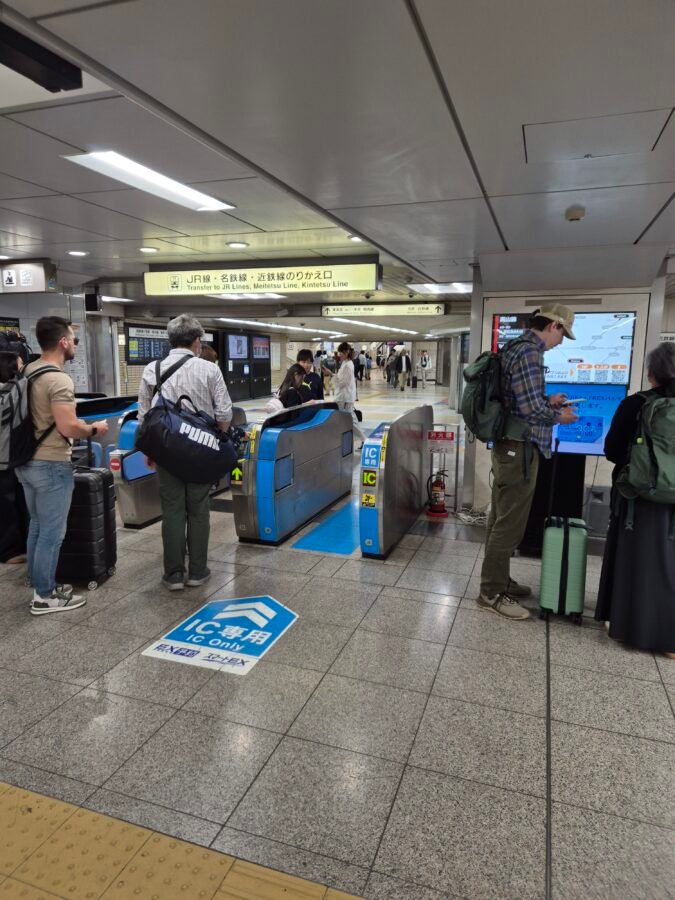
Travelling hands-free changes more than the physical load. Buying ekiben on the platform before a Shinkansen becomes simple again, instead of a juggling act with a suitcase trailing behind you. Train transfers stop being a race against your own bag. I changed trains at Nagoya station, Tokyo to Takayama, on a tight connection through a station I didn’t know. I can’t picture doing that transfer with a 22-kilogram suitcase in tow. Without it, I simply moved.
How I Actually Applied It on My Route
Why Takayama and Sapporo Got Skipped
Takayama and Sapporo both sit at the harder end of Japan’s transit network — smaller stations, longer connections, less straightforward luggage handling than the major hubs. Neither city needed my suitcase delivered there. Both fell well inside the seven-day hold window, so the case simply skipped them and waited for me at the next major stop.
This is the judgement call the rule makes possible: not every city on a route earns a forwarding stop. Some earn a skip instead.
Hiroshima — The Alternate-City Case in Practice
Hiroshima is where the method shows itself most clearly. Rather than forwarding to Hiroshima and again to Fukuoka, I sent the suitcase straight from Nagoya to Fukuoka. Hiroshima became a stop I visited with only the backpack — no reception desk to manage, no paperwork at check-in, no collection to organise on arrival.
One transfer did the work of two. That is the saving, in a single example.
No Two-Day-Ahead Drop — Why the Hold Rule Removes the Deadline
Here is where this route departs furthest from the standard advice. Most guides tell you to bring your case to reception two days before departure, so it lands on the day you arrive at your next hotel. That instruction exists because the standard method forwards to every stop, and every stop has an arrival date to meet.
My method removes that date entirely. Because the provider holds the suitcase regardless, there is no delivery deadline to race. I hand my luggage to reception on the day I check out. Nothing earlier. Nothing held against a clock.
What I do instead is give the hotel advance notice of my plans, well before checkout, so the front desk can prepare the paperwork for a routing that isn’t the usual one they process. Then, at checkout, I check every line of that paperwork myself. My route isn’t standard, and I treat the form as a document worth reading properly, not signing on trust.
Expect the Same Script, Even When It Doesn’t Apply to You
Most front desks run on a script, and the script says bring your luggage down two days before. Staff will tell you this on autopilot, because it’s true for almost everyone else forwarding to every stop on a standard route. It isn’t true for the hold-then-skip method.
This isn’t a confrontation. It’s a gentle correction. I explain, briefly, that I’m holding the bag for several days and skipping a city, so the usual two-day deadline doesn’t apply to my booking. Every hotel I’ve said this to has adjusted without friction. They simply hadn’t been asked to process a request like it before.
Every Hotel Handles It Slightly Differently
The mechanics also vary by property, which is another reason I confirm the process early rather than assuming it. At the Mercure Haneda, the front desk handed me a QR code, and I arranged and paid for the forwarding directly with Sagawa myself. At the Ibis Styles Nagoya and the Crowne Plaza Fukuoka, staff arranged everything on my behalf, and the charge appeared on my hotel bill.
Three hotels, three slightly different processes, the same underlying result. Confirming the process at check-in, rather than assuming it will match the last hotel’s, has saved me from guessing wrong on the day I actually need it to work.
What It Actually Cost
Across the legs I forwarded — including the holding period built into the alternate-city method — the average cost came to roughly AUD30 per leg. That figure includes the convenience of the hold, not just the transfer.
Leg-by-Leg Cost Table
| Leg | Cost (AUD) | Cost (USD) | Cost (EUR) | Cost (GBP) | Cost (NZD) |
| Tokyo → Nagoya (skipping Takayama) | $19 | $13.10 | €11.55 | £9.96 | $23.20 |
| Nagoya → Fukuoka (skipping Hiroshima) | $29 | $19.97 | €17.63 | £15.20 | $35.45 |
| Fukuoka → Tokyo (skipping Sapporo) | $31 | $21.35 | €18.84 | £16.25 | $37.89 |
| Average per leg | ~$30 | ~$20.65 | ~€18.20 | ~£15.70 | ~$36.65 |
Figures reflect 2026 pricing and exchange rates. I won’t be updating these annually, so treat them as a reliable order of magnitude rather than a live quote.
Size, Weight, and Why Cost Climbs With Both
Cost scales with the size and weight of what you’re sending, not just the distance. I travelled with a single suitcase at around 22 to 23 kilograms — comfortably inside the standard limits most providers set, typically around 25 to 30 kilograms and roughly 160 to 200 centimetres in total dimensions (length plus width plus height). A heavier or larger bag costs more per leg than the figures above. One suitcase, within standard limits, is what the pricing in this article reflects.
What If Something Goes Wrong
It hasn’t, for me, not once. Domestic luggage forwarding in Japan carries built-in liability coverage of up to ¥300,000 per parcel as standard, with no separate insurance to purchase. I didn’t add an AirTag, which some travellers do for peace of mind. I made that call deliberately, not by default.
My suitcase carries nothing irreplaceable. My backpack stayed with me the entire time, holding what I actually needed. If the suitcase had been delayed, Uniqlo and Muji are everywhere and inexpensive enough to cover the gap. I travel with more medication than I need, specifically for situations like this, and I keep a copy of every piece of forwarding paperwork. Japan’s systems have proven themselves reliable enough, trip after trip, that I plan around that reliability rather than around the rare exception.
The Hotel Advantage Nobody Frames This Way
This entire system depends on something that has nothing to do with luggage and everything to do with where you stay. Luggage forwarding, run this way, is functionally a hotel-only benefit.
I have stood in hotel lobbies across Japan and watched rows of suitcases lined up by the entrance, tagged and waiting for the same courier I was using. It is standard practice, handled by staff who do this daily, without fuss and without my needing to ask twice.
Why Airbnbs Create Friction Forwarding Can’t Solve
An Airbnb has no front desk. There is no one standing by to receive a suitcase on your behalf, and no one to hand it to a courier while you are out exploring. Unless your host happens to be present at the exact moment of pickup or delivery, the service that works seamlessly at a hotel becomes a logistics problem at a private rental.
This isn’t a workaround issue. It’s structural. Hotel reception is the mechanism the entire system runs on, and an Airbnb simply doesn’t have one.
It can still be done, but the convenience disappears. Convenience stores such as 7-Eleven and FamilyMart, and to a lesser extent Lawson, partner with Yamato Transport’s TA-Q-BIN service and will accept luggage for forwarding. Sagawa Express and JAL ABC run parallel networks, mainly through airport counters and Yamato’s own sales offices. The catch is direction: you can send a bag from a convenience store, but you cannot have one delivered to a convenience store. If you’re staying in an Airbnb and need to collect an incoming bag, you’ll be picking it up from a Yamato sales office, not the konbini (convenience store) on the corner.
In practice, that means an Airbnb guest has to carry the suitcase to the convenience store or sales office to send it, and travel to a separate sales office to collect it. The hotel version of this system removes both trips. The Airbnb version reintroduces the very problem the service exists to solve.
Travelling Light Doesn’t Mean Travelling Without Options
None of this is really about the money. The cost per leg is small enough that saving a few dollars was never the point. The point is what becomes possible once the suitcase is out of the equation.
Carrying only a backpack didn’t stop me from taking a taxi when a situation called for it. In Fukuoka, I took a taxi from my hotel to the airport rather than navigate Hakata Station, one of the busiest in the country, at a time I wasn’t in the mood for it. In Nagoya, I took a taxi from my hotel to the station on a day I wasn’t feeling well. Hands-free travel isn’t a rule to follow rigidly. It’s a default that frees you to choose differently when a day calls for it.
The Blueprint, If You’re Building Your Own Loop
The method, stripped down to its working parts:
- Map your route and identify which stops are genuinely worth a forwarding delivery, and which are short enough — and close enough together — to fall inside the seven-day hold.
- Skip the harder-to-reach or lower-priority cities. Let the suitcase travel past them, not to them.
- Hand luggage to reception on checkout day. No earlier drop, no two-day buffer, because the hold removes the deadline.
- Give your hotel advance notice if your routing isn’t the standard one. Then check the paperwork yourself before you walk away.
- Carry a daypack that holds everything you need for the skipped stretch — mine was seven kilograms, and it was enough for Shinkansen platforms, domestic flights, and everything in between.
I built this system because I was travelling Japan the way I travel everywhere now — without a fixed base, hotel to hotel, for forty days straight. I wrote about exactly why I chose that life in Why I Sold My House and Live in Hotels Instead. The suitcase doesn’t need to keep pace with me. It only needs to be where I am when I actually need it. Everything in between is simply someone else’s job to manage, and in Japan, it turns out, they manage it better than I ever could.